






Shopfloor Digitalization: How toom prepares its frontline for AI
Published:
95 percent of frontline employees have never used AI at work. Not because they don't want to, but because the implementation and the value aren't clear yet. That was exactly what the toom and Flip presentation at Zukunft Personal Europe on September 16, 2026 was about. And that's what shopfloor digitalization is really about. Not the next tool. But the sequence in which you create the greatest possible value for employees on the floor — in their day-to-day work and in their work with customers.
Daria Ezazi (Head of Corporate Communications, toom), Ralf Ludwigs (Lead HR-IT, toom), and Dr. Fabian Winkels (SVP Strategy & Growth, Flip) showed in 25 minutes how toom brought 80 percent of its employees onto one app and what that means for AI on the shopfloor.
 Fabian Winkels
  Dr. Nirmalarajah Asokan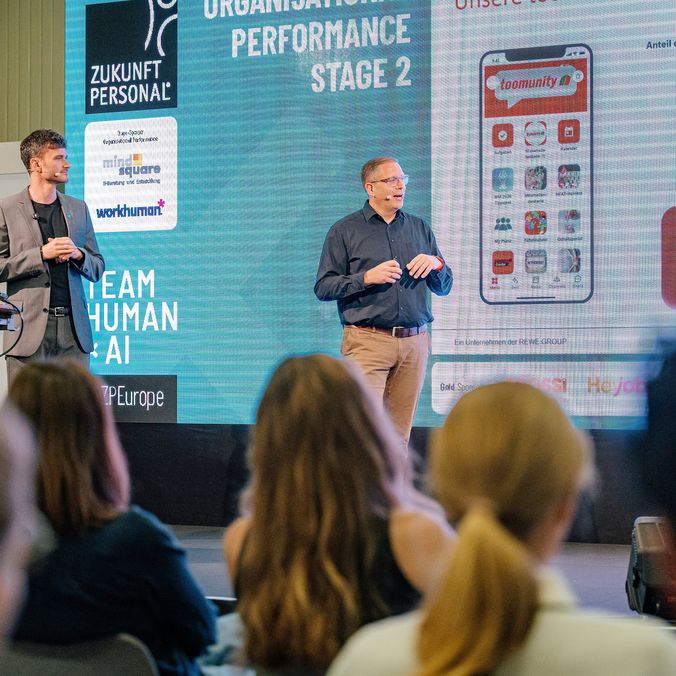
Key Takeaways
Shopfloor digitalization starts with access, not AI. Without a digital identity for frontline employees, without employee login, every AI use case fails at the first step.
95 percent of frontline employees have never used AI at work, while 99 percent of all AI use cases are built for the 20 percent at their desks (Flip/BCG, "AI at Work 2026").
toom brings 80 percent of its employees voluntarily into the toomunity app. The breakthrough came with the integration of MyPlano.
AI needs one frontend, not a portal maze. toom has integrated an AI agent named Bert into its employee app, providing faster answers to questions within the toomunity app.
The sequence is: access before use case, own knowledge before answers, defined process before automation. Those planning the one big case lose time to those who launch a small process live today.
One company, two worlds
The AI revolution is happening almost exclusively at the desk. Twenty percent of the global workforce sits there; 80 percent work without a desk: in a hardware store, at the checkout, in a supermarket, in a factory at Bosch or Porsche. Fabian Winkels brought numbers from a study Flip conducted with BCG ("AI at Work 2026," fourth edition, June 2026) to highlight this gap.
The numbers are clear. 99 percent of AI use cases are built for desk workers — the minority of the workforce. 95 percent of shopfloor employees have never used AI at work. And when they do use AI, they use private tools like ChatGPT twice as often as office workers do, because no business alternative exists. The problem with that is illustrated by a simple example: someone asking their personal ChatGPT about the vacation policy from the shop floor gets an answer from the open web, not from the internal HR policy. What's missing is simply access to their own company's knowledge.
Why AI fails on the shopfloor
Before thinking about use cases, it's worth looking at why AI so often doesn't reach the floor. Winkels names three reasons, and the first is the decisive one.
Access. Frontline employees don't have a laptop, often no company email, and above all no login. You can provide a solution on their personal smartphone, but without being able to identify the person, the value is limited. Anyone who wants to request vacation via AI needs to authenticate first. Without identity management for employees without a PC, no meaningful use case is possible. That's why access comes first, not last, in shopfloor digitalization.
Knowledge. toom went live with its AI, and people on the floor tried it immediately. But if there are a hundred contradictory SharePoint instances in the background, the first user experience is poor and usage drops. Garbage in, garbage out. Knowledge must be accessible and organized first.
Processes. AI can only automate what has first been defined as a process. If a workflow runs through phone calls and word of mouth, there's nothing for AI to build on.
toom's knowledge in your pocket
At this point, Daria Ezazi took the audience back a few years. During the COVID period, toom had a very practical problem: the dynamic decisions around which hardware stores could stay open, and the lack of ways to reach their own employees quickly. Communication ran classically, purely in cascade. This also meant that information didn't always arrive everywhere at the same time, or was sometimes passed on inaccurately.
The first idea for an app at toom dates back to 2019, but the value of such an app wasn't clear at the time. COVID created the openness for it. From planning and selecting a service provider to going live took about a year. The hardest part wasn't the app itself, but the data pipelines behind it: especially the HR interfaces and the question of how the automatic sync of employee data would work.
Ezazi summed up the goal in one sentence: toom's knowledge in your pocket. 18,000 people know a lot, but no one knows who knows what. So toom made this collective knowledge usable. In the "Ask toom" group, anyone can ask a question — from sabbatical applications to the EAN number on a shelf — and in the best case the answer is there within a minute because someone in the store just looked it up. Explicitly not a single point of truth, but shared knowledge that is stored and can be found again later.
80 percent usage: the lever was HR, not communications
Ralf Ludwigs reported from an HR perspective. 80 percent of employees are in the app, voluntarily. The biggest sign-up boost in the employee app came with the integration of MyPlano, the workforce management system for requesting vacation. From that point on, people saw a concrete benefit. The concrete personal value makes all the difference.
This is the real reason why employee access without email works when done right. You need one interface, not ten. Only that way does usage reach these numbers.
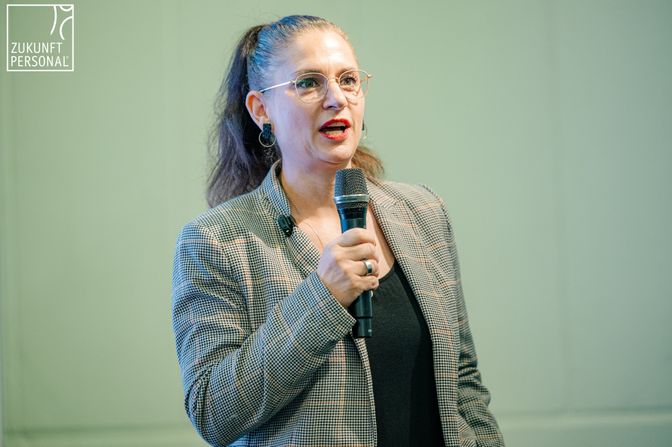
Daria Ezazi, Head of Corporate Communications at toom, presenting at ZP Europe.
Bert: an AI built for employees
toom is now building AI on this foundation. The in-app assistant is called "Bert" — technically, it's Ask AI within the Flip environment. It accesses the knowledge base, posts, and Flows — the content and processes already connected. Pre-defined prompts like "Show me the latest sales updates" are answered directly.
One possible direction for the future: AI pointed toward employees. Ultimately, employees don't care where the system finds the right answer, as long as the solution is there.
At Flip, this mediation is handled by the AI Agent Gateway via open standards like MCP. toom also uses its own AI, the "Tüftelmeister" — an in-house development that helps floor employees find product information faster and advise customers better. The app is never the only solution; it serves as the frontend.
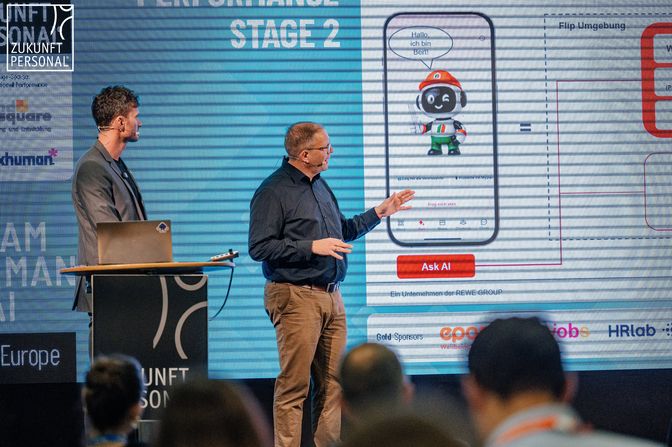
The in-app AI Bert delivers answers from toom's knowledge base.
Three stages: Ask, Act, Build
From working with customers and the BCG study, Flip derives three stages for AI on the shopfloor. They build on each other.
In the first stage, Ask, AI answers company knowledge in real time and in any language. "How do I request vacation?" is answered against the internal source, not the open web. The right metric is the number of questions answered without a ticket.
In the second stage, Act, AI becomes agentic. It doesn't just provide information — it completes the task. For ordering workwear, the employee selects the item and size in chat, sends it, and the AI triggers the order in the right system and documents it. The metric is requests completed without switching apps.
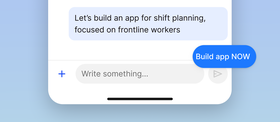
The third stage, Build, is what Winkels finds most exciting right now because it gives the floor control over what gets built. Via an AI app builder — at Flip that's Flip Fusion — apps and workflows can be digitalized in minutes, without a big IT project. Why that matters is shown by Bosch with 400,000 employees: shift handovers look different in each of hundreds of factories. A central IT team rolling out one uniform shift handover app for everyone has never worked and was never economically sensible. Exactly these kinds of processes can now be built locally. Since the app builder launched in June, a three-digit number of apps have already been created with customers, including a store dashboard, a shift handover, and an employee onboarding.
This is how easy it is for the AI app builder Flip Fusion to build apps for the frontline.
The best proof was the World Cup prediction app. The challenge was never building it — it was distribution. Getting an app to 17,000 toom employees through an app store process is cumbersome, and hardly anyone would have downloaded it. When the same app lands in the menu with one click, right next to an entry with 189,602 monthly views, people see it and tap on it. Adoption is incomparably faster. Consumer builders like Lovable can generate an app but can't get it to the floor. That's exactly the difference.
A quote from the presentation captures the limits of automation: Value emerges when processes are rethought end to end. But a frontline process can't be redesigned until it's mapped in the existing systems.
What to take away for your own shopfloor digitalization
The trio highlighted four points at the end, and none of them are specific to toom.
Don't wait for the one big use case. In many companies, an AI project starts with a three-year roadmap and double-digit million savings on paper. Better is a quick win: one concrete process that goes live today, shows management the value, and — more importantly — shows employees. Because that's the only way usage grows.
Sequence is everything. Access before use case, own knowledge before answers, defined process before automation. First you need a digital identity for shopfloor employees and structured knowledge, then AI. If you go live with AI without these foundations, the first user experience is poor.
HR is a co-owner, not a bystander. The degree varies by company, but HR always contributes a significant part to these projects: access and knowledge sources, from HR policies to the question of where those policies even live. Often HR is even the budget owner. At toom, the works council was also involved early on and is now one of the biggest supporters because they see value for themselves too.
And the impact must be felt. The first use case must save employees noticeable time, or there won't be a second.
Frequently asked questions (FAQ): Shopfloor digitalization
Shopfloor digitalization means digitalizing information, communication, and processes for employees without a desk, so they can access knowledge and services directly on their smartphone. For toom, this means specifically: 80 percent of employees use a shared app through which HR services, knowledge, and increasingly AI are delivered.
95 percent of shopfloor employees have never used AI at work, while 99 percent of AI use cases are built for desk workers (Flip/BCG, "AI at Work 2026"). The main reason is lack of access: no laptop, often no company email, and no login to authenticate the person.
toom created a shared interface with the toomunity app and drove usage through the integration of MyPlano. Today, 80 percent of employees are in the app voluntarily.
Three foundations: a digital identity and login for frontline employees, organized and accessible knowledge, and clearly defined processes. Without access, the use case fails at the first step. Contradictory knowledge ruins the first user experience. And without a defined process, there's nothing to automate.
HR is a co-owner, not a bystander. HR provides access and knowledge sources, from HR policies to services like vacation requests, pay slips, and time records. Often HR is even the budget owner for these projects.
Ask, Act, Build. In the Ask stage, AI answers company knowledge in real time. In the Act stage, it completes tasks end to end and documents them in the right system. In the Build stage, frontline teams create their own apps and workflows in minutes via an app builder, without an IT project.

Fabian Winkels
Fabian leads Flip’s global Strategy, M&A, Marketing, and Revenue Operations functions. Since September 2024, he has been responsible for driving Flip’s growth agenda and successfully led the integration of The Bot Platform, Flip’s first-ever acquisition. In early 2025, he expanded his remit to head Flip’s global Marketing across Digital, Field, and Content positioning Flip as the leading AI employee experience platform for the frontline workforce.
Before joining Flip, Fabian was Director of Strategy & Transformation at TK Home Solutions and spent over six years with Bain & Company, where he advised private equity investors and technology leaders on growth, transformation, and acquisitions. He holds a doctorate from RWTH Aachen University.

Dr. Nirmalarajah Asokan
Dr. Nirmalarajah Asokan is Senior Content Marketing Manager at Flip and writes about topics such as HR digitalization, employee apps, internal communications, and AI transformation. With an academic background and many years of experience in content marketing and SEO, he specializes in practical, data-driven content on employee experience, change management, and digital collaboration for modern organizations.
Don’t forget to share this content

More on the topic of Change Management

Why digital experience matters for employee engagement

Digital Workplace: how AI is changing everything

8 digital workplace examples to inspire transformation