83%
of frontline workers don't have a corporate email. This is the single most common reason AI roll-outs stall before they start. Without identity, there is no adoption.
2026 Report
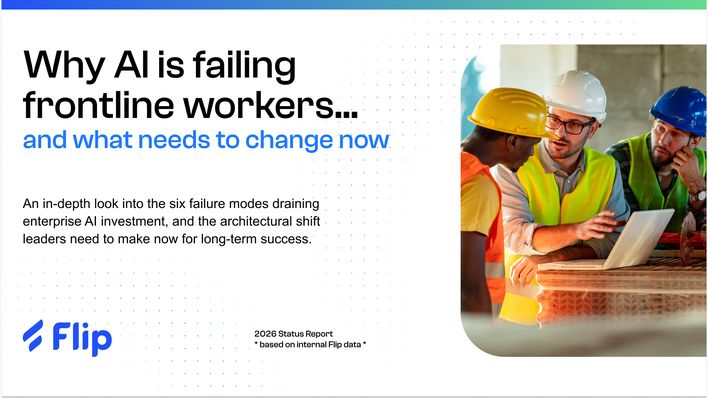
Enterprise AI investment is at an all-time high in 2026. Boards are mandating it. Budgets are being reallocated towards it. And yet, for 80% of the global workforce that works away from a desk (in retail, manufacturing, logistics, and hospitality) almost none of it is reaching the people it was built for. The tools exist. The appetite is real. The failure is architectural.
This 2026 status report, built on Flip's data from more than 1,000 enterprise deployments and primary research with Workplace Intelligence across 1,500+ frontline employees and managers in the UK, US, and Germany, identifies the six points at which frontline AI deployments consistently break down, and shows the architectural choices that have moved leading organizations from sub-20% adoption to over 70%.
The six failure modes that quietly drain enterprise AI investments, and the order in which they must be fixed
Why access, not intelligence, is the binding constraint on frontline AI adoption
How Passkey-based authentication unlocks AI for the 83% of frontline workers without a corporate email
The difference between AI as a layer and AI as infrastructure, and why the second wins
WHY YOU SHOULD READ THIS REPORT

of frontline workers don't have a corporate email. This is the single most common reason AI roll-outs stall before they start. Without identity, there is no adoption.
different AI tools sit side-by-side in 28% of large enterprises. 76% of companies report that this fragmentation has produced a negative outcome.
the typical jump in weekly active usage when a frontline employer rebuilds access around identifiers workers already know, not corporate identity stacks they don't.
INSIGHTS FROM THIS REPORT
83% of frontline workers cannot log in to the tools their employer has bought for them. Multi-factor authentication, corporate email, and app-hopping are not minor UX frictions for someone who has never written a corporate email. They are the reason adoption stalls at 5–10%. Until access is rebuilt around credentials workers already carry (employee ID, date of birth, phone number) every downstream AI investment is operating at a fraction of its potential.
Summarizing a CEO update, drafting a comms email? These are irrelevant to a warehouse picker or a shop-floor associate. Frontline workers' relationship with workplace technology is shaped by immediate, daily utility: finding an answer for a customer, swapping a shift, accessing a safety procedure. If the tool doesn't help with that today, they do not return. And in adoption metrics, a worker who tried AI once and left looks identical to one who hasn't been onboarded at all.
An AI assistant in HR. A chatbot in scheduling. AI search in the intranet. Each useful on its own; together a landscape no frontline worker can navigate under time and physical pressure. The leaders pulling away in 2026 have consolidated AI onto a single daily-use platform or, where that's not yet possible, established one primary AI channel and made it the default for every frontline query.
The question is not whether to deploy AI. It's whether to deploy it as a repository with a chat interface, or as infrastructure embedded in the operational system itself. When AI sits at the system level, it operates within the workflow, connects to the data that makes it useful, takes action rather than only answering, and feeds outcomes back to improve. In Flip's customer base, deployments built this way reach over 75% adoption, on par with knowledge workers.

Book a demo
Tell us your goals, get your questions answered, and receive expert guidance on a 30-minute call.