






Forward 2026: What Flip's Conference Revealed About the Future of Frontline Work
On 17 June 2026, more than 200 decision-makers gathered at SPARK Europe in Frankfurt for Flip Forward: a day of frank debate, live product reveals, and honest conversation about what the AI era actually means for the 2.7 billion frontline workers who don't sit at a desk. Here you can find out which new products were unveiled and which pressing questions were on the agenda .
 Dr. Franzi Finkenstein
  Dr. Nirmalarajah Asokan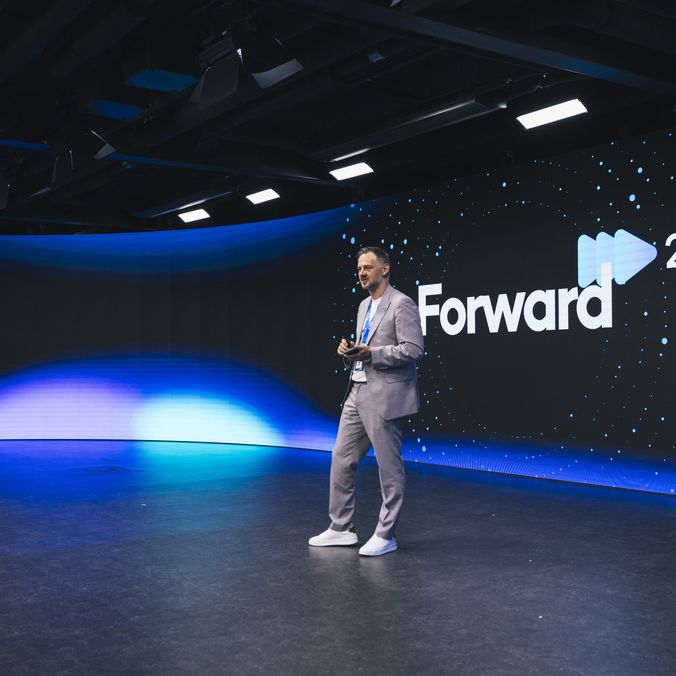
Key Takeaways
Frontline Identity is the first native identity layer built for workers without a company email or PC. Activated by QR code, invite code, or passkey, it eliminates shared passwords and gives every operative employee a secure, personal digital credential that works across all connected enterprise systems, without requiring an external identity provider.
Flip Fusion turns a plain-language description into a fully deployed, enterprise-grade frontline app in minutes. Because Fusion is native to Flip, every app it generates automatically inherits Flip's identity layer, role permissions, design system, and DACH compliance framework. Build and ship are the same action, no IT queue, no deployment wait.
The AI Agent Gateway moves Ask AI from answering questions to executing tasks. By connecting Flip's AI assistant to enterprise systems like Workday, SAP, Salesforce, and Jira via MCP server connections, frontline workers can request shift swaps, absence approvals, or operational data and receive completed actions, without leaving Flip.
The AI Flow Builder generates a complete, multi-step operational workflow. This includes architecture, messages, integrations, task assignments, and permissions, from a plain-language description in under a minute. At Forward 2026, a live demo produced a fully configured staff nomination program in 40 seconds. What previously required a specialist and days of configuration can now be done by any Flip administrator who can describe what they need.
95% of companies still see no return on their AI spend , according to Roland Berger's Marcus Berret, because AI investment continues to target the 20% of workers who already have a desk. Forward 2026 made the case that the real productivity unlock lies with the other 80%, the frontline workforce that enterprise digital tools were never designed for.
The Flip Awards 2026 documented real-world results at scale. For example, TEDi saved district managers 45 minutes per week and hit a 100% process completion rate by automating operations cascades with Flip Intelligence.
Forward 2026 recap: Flip's four product launches and what they signal
Frankfurt. 17 June. A scorching summer day, with outside temperatures pushed past 30 degrees and inside, an energy that no thermometer could measure. The enormous screen, spanning nearly half the room, was already a talking point before the first session began. To the opening chords of "The Final Countdown," against a backdrop of sweeping, space-age visuals that burst through the room like fireworks in slow motion, something happened that no production team can manufacture: people looked at each other, leaned in, started asking questions. It was the electric curiosity of a crowd that had come not just to listen, but to act.
Forward 2026 was not a conference about AI in the abstract. There were no slides about large language model architectures or theoretical futures. What filled the room instead were concrete questions, uncomfortable truths, and, by the afternoon, some answers that were harder to ignore than the usual conference fare. If you attended, you left with a clearer sense of where employee experience for the frontline is heading, and what role Flip will play in ensuring that AI will not fail the frontline moving forward. If you didn't attend, this article is the next best thing.
What followed was not a product launch event in any conventional sense. Forward 2026 moved seamlessly between high-level keynotes and highly practical sessions led by a mix of industry practitioners, Flip product experts, and valued expert partners. By the afternoon, conversations spilled onto the terrace overlooking Frankfurt, where people cooled down with ice cream and kept talking. The heat outside did nothing to dampen the energy inside.
Flip used the occasion to reveal the next chapter of its platform: four product launches that collectively signal something more significant than a feature update. Together, they describe a shift: from a communication tool to a system of action . Here is what was shown, and why it matters.
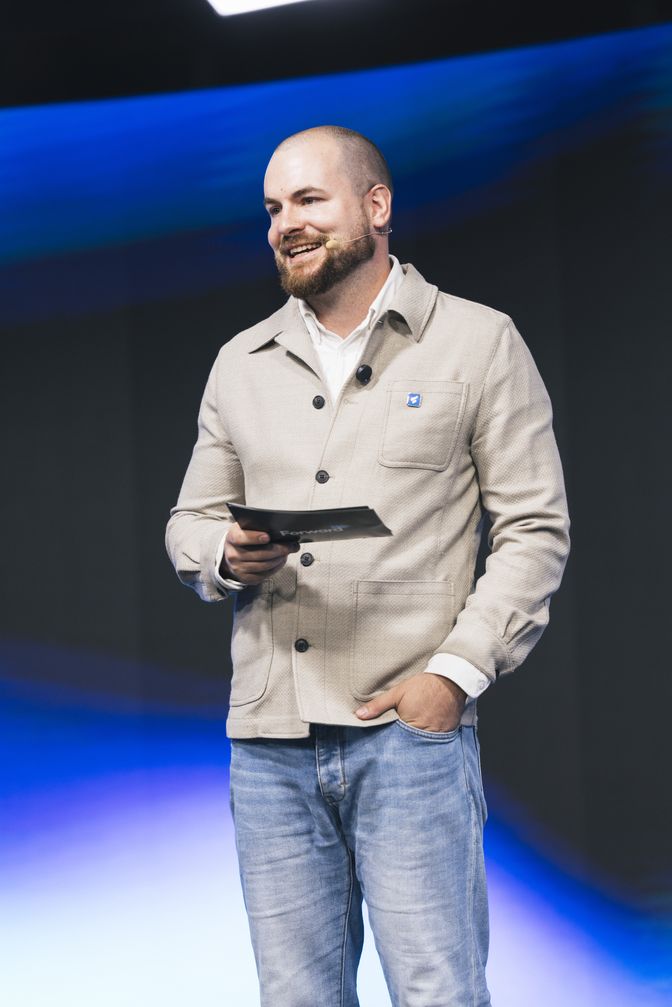
Benedikt Brand, CEO, Flip
The opening that set the tone
Marcus Berret of Roland Berger set the tone for the conference with his keynote "Reimagining Work and the Workforce in the Age of AI." His argument was striking in its clarity: as birth rates fall and Europe's workforce heads toward a loss of 51 million people by 2050, the continent simply can't grow its way forward the old way. This reality was “fundamental for operational life of companies,” Berret emphasized. The only route back to growth runs through real productivity gains, and AI is where that potential lies. Yet Berret was quick to temper the optimism, noting that more than 95% of companies still see no return on their AI spend, because real value emerges only when companies fundamentally rethink how the work itself gets done.
It was an apt frame for everything that followed, because the honest answer is that most AI investment in the enterprise is still being spent on the 20% of workers who already have a computer on their desk. The other 80%, i.e. the warehouse operators, the retail floor staff, the production-line workers and more, remain largely unaddressed.
That is the problem Flip has been building towards solving since its founding. At Forward 2026, the product announcements made that ambition even more concrete.
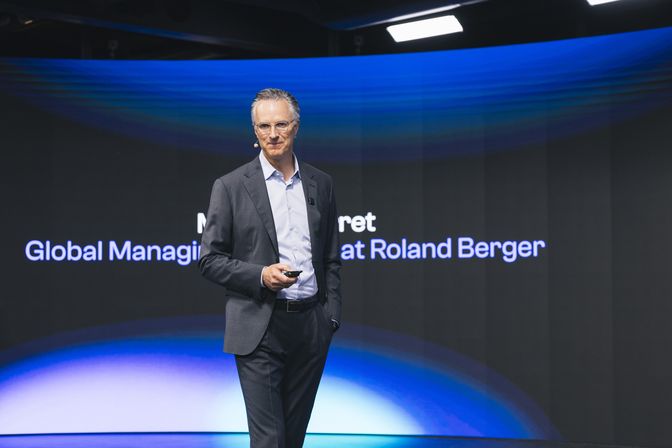
Marcus Berret, Global Managing Director, Roland Berger
Frontline identity by Flip: the first moment of work, reimagined
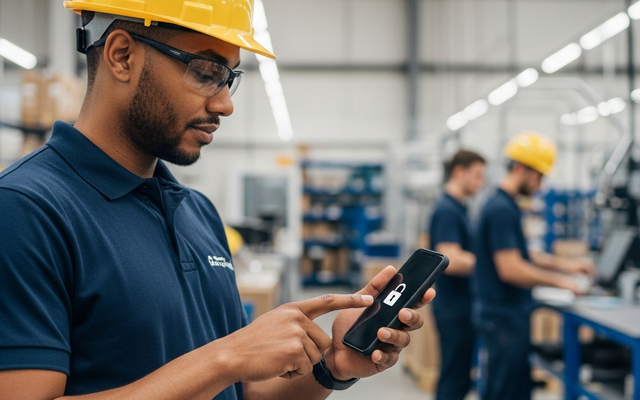
The first and most strategically significant announcement of the day was Frontline Identity, Flip's native identity and authentication layer for frontline teams.
It sounds like an IT infrastructure story. It is, in fact, a worker experience story .
Consider what the first moment of work looks like for a typical frontline employee. They arrive at a shift, pick up a shared device, and face a login screen, sometimes several of them, across multiple systems. For many, that means a shared password pinned to a notice board, a temporary code texted to a supervisor's phone, or a process so friction-heavy that some workers simply give up and ask a colleague. The digital identity of operative employees has been, for years, an afterthought.
Frontline Identity changes this. It gives every frontline worker a secure, personal digital identity. It is one that lives in Flip, works across every connected system, and can be activated through a QR code, an invite code, or a passkey, without requiring an email address . For organizations managing thousands of workers across multiple sites, this eliminates a category of operational and security risk that has been accepted as the cost of doing business with a non-desk workforce.


Jakob Tippelt
Product Manager, Flip
The audience response was telling. When a product announcement lands not as a pitch but as a relief, you know the problem it solves has been felt for a long time. Kira Kebekus, Head of Corporate Communication & Innovation at Europart, spoke on behalf of a lot of guests, when she said: "Finally, I can connect everyone to everything they need."
For HR and IT leaders in the room, Frontline Identity by Flip addresses a challenge that has been growing quietly in parallel with digital transformation: as more enterprise systems move to the cloud and require authenticated access, the identity management gap for frontline workers becomes increasingly expensive to ignore. Our new IAM product is positioned directly at that gap.
AI Agent Gateway: connecting frontline workers to enterprise intelligence
The fourth announcement was perhaps the most forward-looking: the AI Agent Gateway , Flip's connector between the Ask AI assistant and the enterprise systems that hold the data frontline workers actually need.
The practical implication is significant. Imagine a production-line worker who needs a last-minute shift change. Rather than navigating to a separate HR system, logging in, and chasing down a manager, the worker simply makes the request inside Flip.
Via the AI Agent Gateway, the Ask AI assistant alerts the relevant manager, recommends a suitable replacement from the team, and then messages all parties to complete the shift swap, all without leaving the app. It pulls and acts on data directly from systems like Workday, SAP, Salesforce, or Jira, through MCP server connections that IT administrators configure and control. The worker gets a resolution, not just an answer. The system stays secure. The interaction stays inside Flip.
This is AI moving from answering questions to executing tasks, the shift from a knowledge assistant to an operational agent. And the first agents are already taking shape: an Absence Agent built directly into Ask AI, and a custom shift coverage agent that handles one of the most time-consuming realities of frontline work.
The Agent Gateway turns Ask AI from a simple knowledge retrieval tool into a central access point for automations, actions, and integrations, with possibilities that are, frankly, only just beginning to come into focus. The tool is scheduled for general availability in June 2026.

Reach your operational teams 80% faster and more reliably
Flip's mobile app combines messaging, chat, HR tools , and your knowledge base in one secure application. No additional tools or licenses required.
AI Flow Builder: workflows that build themselves
The third announcement addressed something deceptively simple: how do you build a workflow when you are not a workflow designer?
The AI Flow Builder answers that question with a prompt. Describe the process you need, in plain language, and Flip's AI generates the complete workflow architecture: the steps, messages, integrations, tasks, and permissions required to run it. What previously required a specialist and several days or weeks of configuration can now be done by anyone who can articulate what they need.
The onstage demo opened with something disarmingly simple: a screen that read, "Hey Tom, what would you like to build today?"
Tom Gibby, Head of Product Marketing at Flip, typed a prompt. Not a technical specification or a configuration document. A prompt, the way you would describe an idea to a colleague over coffee:
I want to build a quarterly award program where staff can nominate their colleagues for awards based on our existing company values. All nominations should be posted to a channel called 'Staff SuperStars'. Users should select the colleagues they want to nominate…
Within minutes, not days, not a development sprint, not a change request to IT, Flow Builder had assembled the entire app. The nomination flow. The value-based selection logic. The channel integration. The colleague picker. Everything. Plan. Build. Connect. Launch. Forty seconds, start to finish, for a Flow building process that would normally take days or weeks to scope, build, clear through approvals and launch.
When the finished app appeared on that enormous screen, ready to roll out to every employee in the organization. It was the sound of people realizing that something had genuinely shift, that the gap between "we had this idea" and "our people are using it" had just collapsed in front of them.
For frontline organizations, this matters because process design has always been a bottleneck. The processes that govern daily operations (absence requests, shift confirmations, incident reporting, equipment checks) are understood in great detail by the people who live them every day. The gap has always been between that lived knowledge and the technical capacity to translate it into a working digital workflow. The AI Flow Builder closes that gap.
Fusion: from idea to live frontline app, in seconds
The fourth major reveal of the afternoon was the product the room had perhaps been most curious about: Fusion , Flip's AI-native app builder for frontline workforces.
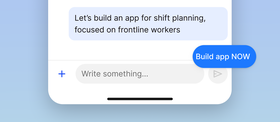
The headline is worth stating plainly: Fusion lets you describe the app you need, in natural language, and watch it come to life, fully integrated into Flip, authenticated for every worker, role-aware, connected to your HR system, and ready to ship across your entire workforce . From idea to live frontline app, in minutes, not months.
Describe it. Build it. Ship. It. In one touch.
The onstage demo made this viscerally clear where Luke Talbot, Senior Vice President Research & Development, showed a concrete example of the Shift Handover App , a "simple to-do app" built within Flip: The audience saw a prompt beginning with, "I want a form in Flip that users can fill in. They need to be able to select the user they're handing over to, so it needs to get that off Flip's API, I guess. It also needs to know the user that's filling out the form automatically. And I could describe the whole thing here, but let's grab that photo and attach it, to save time. Just replicate all those things in the form, and make it nice. Just." Additionally, the creator of this handover process saves it as a concrete task.


Luke Talbot
Senior Vice President Research & Development
A sequence later, the audience watched how the a "shift handover report" is attached to the prompt. A new screen appears asking "Who's taking over the shift?" with colleagues to choose from, and the handover can be sent in just a few steps. A single publish button builds this handover app within seconds. As the demo says:
in one touch, thousands of frontline workers have new tools available. No code. No waiting, No barriers.
What happened next on stage drew a real reaction. As the publish button was pressed and the finished app materialised almost instantly, a ripple of audible surprise moved through the room, the kind of spontaneous "oh" that comes when something you assumed would take a development team weeks happens in front of you in seconds. There was a beat of recognition, then applause, as the audience realized they hadn't just watched a slide about AI but a working app being spoken into existence. A few laughs broke out at the casual "make it nice" prompt and the very human, thinking-out-loud way the request was phrased, and the warmth in the room was unmistakable: this was the moment the abstract promise of agentic AI for the frontline became something people could actually see working.
Ralf Ludwigs
Lead HR-IT, Processmanagement & Analytics at Toom
What makes Fusion categorically different from every other AI builder on the market is not the generation capability. It is what happens immediately after. A Lovable-built app or a PowerApps flow still has to find its way to 50,000 frontline workers through layers of identity management, device provisioning, permissions configuration, and IT sign-off. In most organizations, that process takes weeks. Often months.
Benedikt Brand
CEO, Flip
Fusion collapses that entirely. Because it is native to Flip, every app it builds inherits Flip's identity layer, Flip's role and permissions structure, Flip's design system, and Flip's compliance framework, including the DACH-specific requirements that enterprise IT and works councils require before anything touches a frontline worker's device. Build and ship are the same action.
Bala Sathyanarayanan
CHRO at Greif
Ultimately, this is not a product for developers. It is a product for the HR director who has spent two years waiting for IT to build an absence-reporting app. For the operations manager who knows exactly what their team needs but has no path to building it. And for the organizations that have been told, repeatedly, that software takes time and have accepted that answer because there was no alternative.
What the Customer Stories Confirmed
The product announcements did not stand alone. They were grounded by something more valuable: customer stories from organizations that have already walked some of this path.
Representatives from HELLA, toom Baumarkt, and CSL each described, in concrete terms, what digital transformation looks like for a frontline workforce.
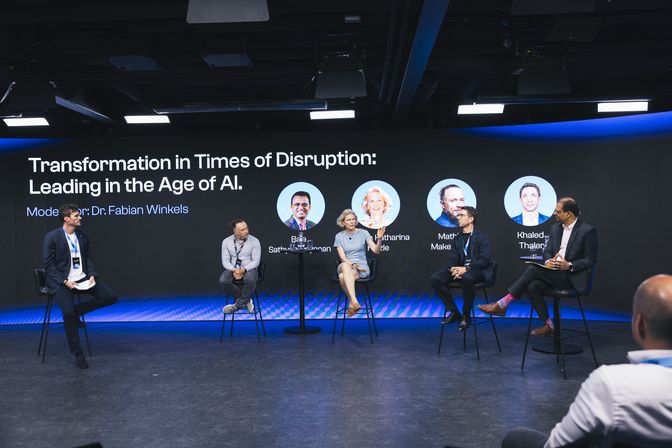
And then there was the research frame provided by Prof. Dr. Katharina Hölzle of Fraunhofer IAO, whose session on the human side of AI in the workplace gave the day a necessary counterbalance.
In it, Holzle talked about how the AI revolution is different from other technical revolutions. “AI is quicker, faster, and the way we're using the machine, or the machine is using us, is different," she observed. The distinction matters more than it might first appear. For most of industrial history, humans managed machines: we gave the commands, the machine complied. That relationship has fundamentally shifted.
Prof. Dr. Katharina Hölzle
Director IAT University of Stuttgart and Executive Director Fraunhofer IAO
It is a question with real urgency. AI is no longer a discrete tool sitting inside a single workflow, it has become a cross-cutting technology, embedded in communication platforms, HR systems, operational processes, and decision-making loops simultaneously. Its adoption is not gradual; it is structural. What Hölzle's research makes plain is that the transformation underway is not one organizations can observe from a safe distance. The machine is already inside the work.
The combination of research, customer evidence, and product demonstration is what separated Forward 2026 from a product launch event. That tension, between acceleration and agency, between capability and control, ran like a thread through everything discussed at Flip Forward .
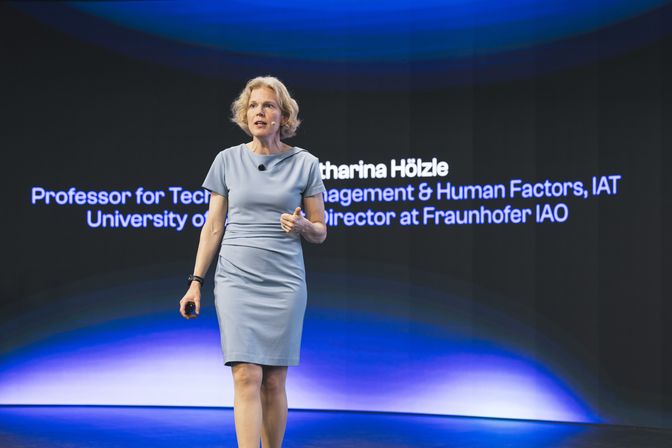
Prof. Dr. Katharina Hölzle, Director IAT University of Stuttgart and Executive Director Fraunhofer IAO
The Flip Awards 2026
The Flip Awards have become, in their second year, a meaningful signal of what excellent frontline transformation actually looks like in practice.
Winner: Sonderpreis Baumarkt took home the award for Best Use of Flip Intelligence , with their AI assistant SMILE achieving the highest AI usage rate of all Flip customers. They earned a spontaneous round of applause.
Honorable Mention: TEDi stood out for using Flip Intelligence to fully automate their global operations cascades, saving district managers 45 minutes per week and hitting a 100% process completion rate.
Honorable Mention: TK Elevator was recognized for building Suzi, an AI-powered HR assistant that saves frontline employees up to 45 minutes per week, striking the judges for the way it paired AI capability with genuine human connection.

What Forward 2026 Signals for the Market
Step back from the individual announcements and a coherent picture emerges. Flip is building a complete frontline operating system: identity at the foundation, communication and workflows as the daily interface, AI as the intelligence layer, and an app builder that lets organizations extend and adapt without depending on development resources.
The 80% of the global workforce who work without a desk are not a niche. They are the majority. They are also, as the REWE Group session made clear, the workforce whose digital experience has lagged furthest behind their desk-based counterparts. Not because the problems are harder, but because the tools were never designed with them in mind.
That is changing. And Forward 2026 was a useful marker of how much has changed in a very short time. The frontline is no longer the last stop on the digital transformation journey, it is becoming its starting point. What the conference made clear is that the question is no longer whether AI will reach the frontline, but how quickly organizations are willing to shape that shift alongside it. Flip did not present a finished answer on that day. It showed how it asks the question.
Luke Talbot
Senior Vice President Research & Development
See a recap of Forward 2026 here:

Dr. Franzi Finkenstein
Dr. Franzi Finkenstein is part of the Content & Search team at Flip, writing about digital communication, employee engagement and AI–human connections. Drawing on a humanities PhD and extensive editorial experience, she focuses on how digital technology is reshaping the future of work and explores how employee health and wellbeing in modern workplaces can be improved.

Dr. Nirmalarajah Asokan
Dr. Nirmalarajah Asokan is Senior Content Marketing Manager at Flip and writes about topics such as HR digitalization, employee apps, internal communications, and AI transformation. With an academic background and many years of experience in content marketing and SEO, he specializes in practical, data-driven content on employee experience, change management, and digital collaboration for modern organizations.
Don’t forget to share this content

More on the topic of Future of work
Identity access management: a guide for the frontline era
What is identity fabric? A 2026 guide for HR and IT leaders
Phishing resistant login: 2026 guide for frontline teams