






What is a no code app builder? A 2026 guide for HR and IT leaders
Published:
In a A Pattern Language (1977) the architect Christopher Alexander argues that the people who use a building should design it. Half a century later, that quiet idea has crept into enterprise software. The same principle now shapes how the most useful frontline tools get built, with no code app builders handing the pen to the people who actually do the work. The shop floor is starting to draw its own blueprints.
This article asks what happens when an HVAC technician with no coding skills builds a production-ready app between two shifts, and how you keep that creativity inside a secure identity fabric without strangling it. One question before we begin: if your frontline could build their own tools, what would they fix first?
 Dr. Franzi Finkenstein
Key Takeaways
A no code app builder turns operational employees into citizen developers, and the model has now gone mainstream. Forrester reports that 89 per cent of development executives are already implementing or planning a citizen developer strategy, and there are roughly 16.2 million citizen developers worldwide in 2026, up 38 per cent year on year
Gartner expects 70 per cent of new enterprise applications to use no code or low code platforms by 2026, up from less than 25 per cent in 2020. The market is on course to reach $44.5 billion in the same year, growing at 19 per cent CAGR
Speed without identity governance is a liability. A Microsoft study found 54 per cent of IT executives suspect their frontline workers already use unsanctioned shadow IT, and OWASP now publishes a dedicated Top 10 risk list for no code platforms. The best no code app builder is the one wired into your employee experience platform, your single sign-on, and your identity fabric from day one.
Where the citizen-developer movement actually stands
The case for a no code app builder no longer rests on individual vendor success stories. It rests on a well-documented shift in how enterprises are choosing to build software at all.
Forrester's February 2025 report, Citizen Development Will Rewrite The IT Operating Model, found that 89 per cent of development executives say their firm is already implementing or actively planning a citizen developer strategy, and 42 per cent are prioritizing AI-infused applications as a primary use case (Forrester, 2025). Forrester's language is unusually direct on this point. Citizen development is moving from a discrete IT program to a core pillar of how enterprises build software.
IDC adds the market dimension. The worldwide low and no code IT development market is forecast to surpass $21 billion by 2026, with a 17.8 per cent compound annual growth rate, and by 2026 around 80 per cent of low code users will sit outside formal IT departments altogether. There are now approximately 16.2 million citizen developers worldwide, a 38 per cent jump in a single year.
For frontline organizations, the implication is structural. The people closest to the work are no longer waiting for IT to build the small process apps that shape their day. Across documented enterprise programs, a consistent pattern emerges. A governed citizen-developer model compresses delivery from months to weeks, reduces shadow IT by giving app creators a sanctioned environment, and quietly redistributes authorship. Decisions about how a maintenance technician should log a fault are no longer made in a sprint planning room three time zones away. Line technicians, shift leads, and quality managers now draft the first version of the tools that shape their day, and the central IT team becomes a curator rather than a bottleneck.
That is the deeper story of the no code app builder in 2026. The headline is speed. The substance is governance.
What is a no code app builder, really?
A no code app builder is a visual builder that lets people create apps without writing code. Where developers once typed in Java or Swift, a no code platform offers a drag and drop builder, prebuilt components, basic logic blocks, and ready-made templates. The output is a functional app, often a native mobile app or web app, sometimes a simple branded app for client portals, sometimes a complex workflow that ties together existing data, existing databases, and a stack of api configurations.
The category itself is broad. On one end sit consumer-grade tools that let small teams produce a booking app over coffee, with paid plans starting around £29 per month and a free tier or free plan to test the waters. On the other end sit enterprise-grade systems that generate custom apps with true native iOS support, enterprise grade security, advanced functionality, and code export to Flutter or React Native for teams that occasionally want to drop into custom code.
Jotform Apps lives near the lighter end. Glide app and Adalo aim at builders who want unlimited projects and a simple onboarding path. Microsoft Power Apps, OutSystems, and Mendix sit at the enterprise tier, with ai builder modules, deep workflow automation, and the kind of api connector library that matters when you are connecting to SAP, Workday, or a homegrown MES.
Three things separate the best no code platforms from the rest.
The first is how much control the platform gives a non-developer. Drag and drop interfaces feel similar across vendors. The real divergence is in basic logic, complex data relationships, and the api connector library. A platform that handles a simple form but breaks the moment you need to enrich data from two existing databases is not building powerful apps. It is building demos.
The second is deployment. A Glide app or Jotform Apps build can be shared as a link or installed as a progressive web app. Microsoft Power Apps can deploy apps to Teams, the Apple App Store, the Google Play store, and Android apps with native packaging. The best no code app builder for a frontline workforce is the one that respects how operational teams actually use their mobile device, which is rarely through a desktop browser and almost always offline at some point in the day.
The third, and most underestimated, is integration with identity, data infrastructure, and ai features. This is where most no code tools either grow up or get quietly removed by IT.
A useful way to read the category is by the kind of work the platform was built for. Some no code tools were designed to help marketers spin up landing pages, signup forms, and small consumer apps. Others were designed for HR teams to build self-service portals on top of existing databases. A third group, sitting closer to power apps and Mendix territory, was designed from the start for building internal tools that talk to legacy systems through a deep api connector library.
Treating these three as interchangeable is one of the most common procurement mistakes of 2026. A no code app builder optimized for a free tier signup flow rarely scales into a production ready app for a thousand frontline workers, and a platform built for complex enterprise apps rarely makes sense for a five-person team that wants a quick booking app.
The market is moving fast, and so is the search intent
The phrase "no code app builder" sits at the intersection of two distinct search intents. The first is informational. HR directors, IT architects, and operations leaders type it into Google because they want to know whether it is realistic to digitize a workflow without hiring developers. The second is comparative and commercial. Citizen developers and procurement teams are evaluating which no code platform actually deploys apps that survive enterprise scrutiny.
Both intents share an underlying question. Can a no code app builder honestly replace writing code for a production ready app, and where are the edges?
The market data suggests the answer is increasingly yes, with caveats. Gartner has been blunt for two years. By 2026, 70 per cent of new applications developed by enterprises will utilize no code or low code technologies, against less than 25 per cent in 2020. The total low code development market is forecast to hit $44.5 billion in 2026 at a 19 per cent compound annual growth rate. The narrower drag and drop app builder segment is on track to reach $8.4 billion by 2032.
The implication is structural. Inside every enterprise with more than a thousand frontline employees, hundreds of small process apps will be built without a single line of writing code. Whether they are built well, governed sensibly, and integrated with the wider data infrastructure depends on choices made in the next twelve months.
Search behavior reinforces the point. The "best no code" qualifier shows up repeatedly in long-tail queries because buyers know the category is crowded and uneven. Searches for "no code app builder for client portals", "best no code platform for android apps", and "how to deploy apps without writing code" all signal a buyer who has moved past awareness and is hunting for fit. Content that helps that buyer compare honestly, including limitations, wins citations in Google's AI Overviews and in ChatGPT responses, which is how the next wave of evaluation traffic arrives.
How a no code app builder transforms create apps work on the frontline
The conventional story of no code app building assumes office workers automating spreadsheets. That picture badly underestimates what is happening in retail back rooms, machinery cells, logistics hubs, and food service kitchens.
Frontline app creators are not building Slack clones. They are creating practical tools like defect logging apps for production lines, temperature check apps for cold storage, and shift swap mini-apps that integrate with HR systems. They also build simple branded apps for contractor safety reports, audit checklists to replace paper processes, and booking tools for shared equipment.
A pattern emerges across these examples. The work the no code app builder enables is rarely a single brand-new system. It is the connective tissue between existing data, an existing database, and a frontline mobile device that previously had no software access at all.
The benefits are real and measurable. Building internal tools through no code apps tends to compress delivery cycles from quarters to weeks. It removes the bottleneck of hiring developers for every small need. It gives operational employees a sense of agency that no engagement survey can manufacture. And it surfaces the small process improvements that professional developers rarely see, because the people closest to the work are the ones doing the modeling.
There is also a workforce dimension worth naming. McKinsey's recent research on the frontline of the future found that nearly three-quarters of workers report meaningful skill gaps, with technology skills sitting at the top of the list leaders prioritize (McKinsey, 2024). A no code platform turns the technology learning curve into a participatory one. Workers do not need to wait for a six-week training program to begin shaping their digital environment.
Consider the everyday economics of this. A retail store manager who spots a recurring stockroom problem can sketch a fix in a visual builder during a quiet half-hour, deploy apps to a handful of tablets, and watch whether the change holds. If it does, the regional operations team picks it up. If it does not, the cost was a Tuesday morning. This is what citizen development at the frontline actually looks like when the no code platform is good enough to support it. The point is not to replace professional developers but to give the people closest to the problem a way to try a solution without filing a ticket and waiting six months.
Where no code tools quietly fail
The best no code platforms are honest about their limits. The less mature ones are not, which creates risk for any enterprise pulled in by the marketing.
Three failure modes show up consistently.
The first is complexity drift. A no code app builder is wonderful at simple apps. The moment a workflow grows into complex apps with complex data relationships, branching basic logic, multi-step approvals, or real-time integration with existing databases, many tools struggle. Teams end up either reaching for custom code workarounds, paying for enterprise plans they did not budget for, or quietly hiring developers to maintain the so-called no code stack.
The second is shadow IT in a friendly wrapper. The second is shadow IT in a friendly wrapper. Microsoft's 2024 Work Trend Index found that 78 per cent of AI users now bring their own AI tools to work, often without IT's knowledge (Microsoft, 2024). When IT cannot keep up, well-meaning citizen developers reach for whatever no code tool accepts a credit card. Each one stores data outside the enterprise's identity and access boundaries. OWASP now publishes a Top 10 list specifically for no code and low code platforms, naming risks like authentication misuse, account impersonation, and unauthorised data exposure. Speed without governance is a leak waiting to be discovered in an audit.
The third is the integration cliff. Most no code app builders connect easily to Google Sheets, a few SaaS tools, and a thin api connector library. They struggle the moment they meet a legacy MES, a SAP module, or a HR system that does not offer a clean REST endpoint. For frontline organizations whose existing data lives in older systems, this gap is the difference between a useful pilot and a discontinued project.
A fourth failure mode is more cultural than technical. Many no code platforms attract a free plan audience, build a community of hobbyist app creators, then leave enterprise customers to navigate the leap to paid plans on their own. The result is a feeling of bait-and-switch when a procurement team discovers that push notifications, unlimited users, custom domain support, and enterprise plans live behind a price tier roughly ten times higher than the marketing suggested. Read the pricing page before the demo, not after.
This is the gap that the next generation of enterprise platforms is built to close.

Reach your operational teams 80% faster and more reliably
Flip's mobile app combines messaging, chat, HR tools, and your knowledge base in one secure application. No additional tools or licenses required.
What separates the best no code platforms from the rest
If you are evaluating no code app builders for a frontline workforce, the marketing pages tend to focus on the drag and drop builder and the ai features. Those matter, but they are table stakes by 2026. The harder questions sit underneath.
Identity and access management. Does the no code platform plug into your single sign-on, your identity fabric, and your biometric login? Frontline workers cannot afford to manage six new user accounts for six new internal tools. Every additional credential is friction at the moment of work and an attack surface for the security team.
Data infrastructure. Where does the data go when an app is built? Does the platform store it on its own backend, force you into a third-party Google Sheets workflow, or let it sit inside the data infrastructure and data storage your IT teams already trust? Enterprise plans usually answer this well. Free plans and consumer apps rarely do.
Workflow automation. Real work on a shop floor extends well beyond a single screen of input fields. It involves an event that triggers a workflow that talks to three systems and ends in a notification. The best no code app builder gives you visible, governable workflow automation rather than hidden chains of conditional logic.
Deployment surface. Can you deploy apps to true native iOS, Android apps, the Apple App Store, the Google Play store, and a web app with the same source, with the option to add features over time without rebuilding from scratch? Or are you committing to one deployment path and rebuilding for the others? Some platforms now offer export Flutter code or native code export as a release valve, which professional developers can pick up if a native app or wider web applications portfolio outgrows the no code wrapper.
AI features that compound rather than dazzle. An ai builder that helps generate custom apps from a prompt is impressive. An ai feature that lives inside the deployed app and helps the worker complete a task is transformational. The distinction matters. Most platforms will offer the first by the end of 2026. Far fewer will deliver the second well.
Pricing reality. Free plans, free tier offers, and consumer apps work for proofs of concept. They rarely survive contact with enterprise procurement. Paid plans start where the api connector, custom domain, advanced functionality, and unlimited apps begin to appear. Enterprise plans are where push notifications, unlimited users, and enterprise grade security become defaults rather than upgrades.
Honest support for non-developers. A platform that promises "no code" but expects api configurations written by hand is not really a no code platform. It is a low code platform with better marketing.
How AI Is Reshaping Identity and Access Management
Here is where the conversation gets genuinely interesting, and where most companies are still underprepared.
For the past forty years, IAM has assumed one thing: that the entity requesting access is a human. Human users had passwords. Authenticated users had sessions. Authorised users triggered actions. The model worked because the population of identities was finite and largely visible.
That assumption is now collapsing.
By the end of 2026, most enterprises will be operating dozens, then hundreds, of AI agents, i.e., software entities that act on behalf of human users to retrieve information, complete workflows, and trigger transactions. Each of these agents needs an identity. Each needs access permissions scoped to only the permissions required for its task. Each needs to be auditable, revocable, and observable. A Gartner forecast published in November 2025 estimates that by 2028, agentic AI will autonomously make at least 15 per cent of day-to-day work decisions in large enterprises, up from effectively zero in 2024.
That is a population explosion in the identity management database. It is also a profound shift in what identity protection means. The traditional perimeter, keep bad people out, let good people in, no longer holds when half the actors on your enterprise network are non-human.
What Forward-Looking Companies Are Doing Differently
The companies thinking clearly about this are doing three things.
First, they are extending strict access controls and granular access controls to AI agents, treating each agent as a first-class identity with its own role, its own scope, and its own audit trail. Second, they are using attribute based access control to apply real-time context — what the agent is doing, on whose behalf, with what data — rather than relying on static role definitions. Third, they are designing their iam solutions so that human workers and AI agents can collaborate inside the same workflow, with consistent identity information, consistent governance, and consistent secure access.
For frontline workforces, this is more than a security story. It is the difference between an AI assistant that can actually help a shift supervisor reschedule a team in two seconds, because it has the right identity, the right permissions, and the right context, and one that can only answer questions.
Compliance, Risk, and the Hidden Cost of Doing Nothing
It is tempting, in a topic this technical, to treat compliance as a footnote. It is not.
The cost of weak access management software shows up in several places at once. Regulatory fines under the general data protection regulation can reach four per cent of global annual turnover. Breach costs, according to IBM's 2024 Cost of a Data Breach report, average USD 4.88 million globally, with credential-based attacks among the most common entry vectors. Security risk sits on the balance sheet whether or not it is named there.
The hidden costs are arguably worse. Time gets lost to denying access that should have been granted, to granting access resources that should have been denied, recertifying user identities through clunky quarterly reviews, or time gets lost when authorised users cannot request access to a system because the workflow lives in three different tools.
A mature IAM system collapses these costs. It enforces restrict access rules automatically, recertifies access rights continuously, and treats manage identities as a real-time function rather than a quarterly project.
The companies that take this seriously now will be the ones who, two years from now, can confidently say: every human and every AI in our enterprise has exactly the access they need, no more, no less, and we can prove it.
The Future Belongs to Platforms That Empower the Worker, Not Just Protect the System
A useful test for any identity strategy in 2026 is to ask whose experience it improves. If the answer is "the IT department" or "the audit team," the strategy is incomplete. If the answer is also "the employee on shift right now, whose first interaction with their employer this morning is opening an app," then the strategy is in the right shape.
This is the deeper argument behind Flip's bet on identity. A platform that already sits in the worker's hand, that already understands their role, their schedule, and their location, is structurally better placed to control access, manage access, and protect sensitive information than a stack of systems bolted on from a corporate office that the worker has never visited. Identity management at the edge of the organization cannot be retrofitted from the center. It has to be purpose-built for the place where the work actually happens.
When AI joins that workforce, and it will, faster than most companies are ready for, the platforms that have already solved identity for the frontline will have a decisive head start. The rest will spend the next three years trying to bolt agent identity onto an architecture that was never designed for it.
The AI dimension: where no code app building meets the agent era
For two decades, internal apps were static. You filled in forms, you submitted requests, you waited for a response. The arrival of conversational and agentic AI has changed that picture in a single product cycle.
A modern no code app builder no longer just lets you create apps. It lets you create apps that can call AI, summarize unstructured data, propose actions, and trigger workflows that previously required a developer to glue together. McKinsey's 2025 research on the productivity unlock notes that nearly 80 per cent of companies are using generative AI in some form, but more than 60 per cent report no significant bottom-line impact. The gap rarely lies in the model itself. The missing piece is a portfolio of small, well-built apps that put AI where the work happens.
That is the niche a no code app builder fills, if the platform is mature enough. A frontline worker should be able to talk to a maintenance assistant, ask for the closest available technician, file a report by voice, and trigger the next workflow in one motion. None of that is theoretical. The components exist. They simply need to be assembled, governed, and made accessible inside the tools the worker already uses.
The implication for IT teams is sobering. Every no code app deployed into a frontline workforce is now potentially an AI-enabled app. The question of identity, data infrastructure, and access controls is no longer a security afterthought. It is the foundation that determines whether the AI inside the app is auditable, attributable, and contained.
There is a second, less discussed, consequence. AI inside a no code app builder shifts the role of the citizen developer. Earlier waves of no code asked the builder to translate a process into a series of screens and forms. The current wave asks the builder to translate a process into a description of the work, with the ai builder then proposing the screens, the basic logic, and even the api configurations. This is much faster, and also much easier to do badly.
A well-prompted ai builder can generate custom apps in just a few minutes. A poorly-prompted one can generate the kind of subtly wrong application that runs for six months before anyone notices the audit trail is incomplete. Governance, in other words, becomes more important as the no code platform gets smarter, not less.
Where Flip fits: a builder that ships inside the identity fabric it inherits
For organizations whose workforce is largely frontline, the most useful no code app building happens inside a platform that already owns the worker's digital identity. Flip is an employee experience platform built around the reality that frontline workers do not sit at a corporate desk, combining communication, HR self-service, workflow automation, and increasingly AI agents, inside one mobile-first app that lives on a worker's phone and accepts biometric login at the moment of use.
Frontline Identity by Flip sits underneath, giving every frontline worker a single, secure credential that opens the apps, mini-apps, and workflows they need without juggling six logins. That layer is what prevents the speed of no code from creating shadow IT at scale.
Plain-language building on a governed foundation
The article's central tension is the one most no code platforms leave unsolved. Speed is easy. Governance is hard. A store manager can sketch a fix on a Tuesday morning, but the app that results still has to be authenticated, distributed, made compliant, and connected to the systems that hold the real data. This is exactly the gap Flip Fusion was built to close.
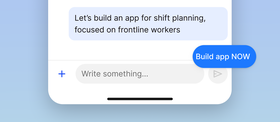
A builder describes the app they need in plain language, the way they would write a message to a colleague, and Fusion produces a working app that already lives inside the Flip app the workforce uses every day. There is no separate sign-in to wire up and no app store submission, because the app reaches the right workers in one touch, on the device already in their pocket, online or offline.
What makes that safe at scale is the platform around it. Every Fusion app inherits its access layer from Frontline Identity, so the citizen developer never has to build single sign-on, choose a data residency, or decide who is allowed to open the app. Those decisions are solved by architecture rather than left to each builder to get right. The same apps plug straight into the AI Workflows, so a defect log or a shift-swap tool can trigger approvals, route tasks, and feed data back into HR and operations systems without anyone retyping it.
For a frontline organization that wants the creativity the article describes without the shadow IT it warns against, that combination of plain-language building, inherited identity, and connected workflows turns a good idea on the shop floor into a production app the whole company can trust.
On-site example: Picture a grocery retailer with 400 stores and a recurring stockroom problem nobody in central IT has time to fix. A regional manager opens Flip Fusion, describes a chilled-goods waste log in plain language, and within the hour every store on her patch has a working app on the shared handsets. Because it inherits Flip Identity, only the right colleagues can open it, and no one had to set up a login or a database. The log routes overdue items to the duty manager through AI Workflows, and a store assistant can ask Ask AI what the markdown policy says without leaving the app. What would once have been a six-month IT ticket becomes a Tuesday-morning fix that is governed, secure, and live across the whole estate.
What HR and IT leaders should do in the next six months
The conversation about no code app builders has moved past whether to adopt them. The relevant question is how to do it in a way that compounds value rather than risk.
A short, pragmatic plan tends to look like this.
Map the existing landscape. Find the apps and spreadsheets your operational employees are already using. Some will be sanctioned. Many will not. Both tell you where the demand for a no code platform is most acute.
Pick one no code platform per use-case tier. A consumer app builder for low-risk simple apps is fine. A no code app builder with enterprise grade security and deep api connector support is necessary for anything touching customer data, payroll, or operational technology. Avoid the trap of one platform for everything.
Wire the platform into your identity fabric on day one. If the no code platform does not support single sign-on, biometric login, or your existing identity governance, treat that as a deal-breaker. The cost of retrofitting identity later is always higher than the cost of building it in now.
Train deliberately. Bosch's success came from weekly training sessions, not from a single onboarding webinar. The learning curve of a no code tool is short. The learning curve of governed, production-ready app building is longer.
Measure adoption, not deployment. The number of apps deployed is a vanity metric. The number of frontline workers who use those apps weekly is the metric that matters. A booking app no one opens is not a win.
Plan for AI from the start. Any no code platform you adopt in 2026 will have AI features inside two years if it does not already. Choose vendors whose AI roadmap aligns with your identity, governance, and data infrastructure principles.
The next decade belongs to the people closest to the work
The no code app builder of 2030 will look different from the one you evaluate today. The drag and drop builder will still be there. The visual builder will be smarter. The ai builder will be capable of generating custom apps from a sentence rather than a screenshot. Code export to Flutter and other frameworks will be standard. Push notifications, custom domain support, and unlimited users will sit even in the free tier.
The real change will be elsewhere. The boundary between a no code app and a workflow will dissolve. App creators will compose flows that span systems, agents, and humans, with the no code platform acting as the orchestration layer rather than the destination. Production ready app delivery for operational teams will look less like building screens and more like teaching the platform what the work is.
Frontline workers will be at the center of this shift, not the periphery. They are closest to the work, and they are the ones whose tools have been most underserved by the last twenty years of enterprise software. A no code app builder, woven into a secure employee experience platform with a robust identity fabric and proper AI orchestration, is the closest the industry has come to giving them what knowledge workers have had for two decades. A way to shape their own digital environment.
Christopher Alexander's argument was that the people who use a building should design it. Half a century later, the shop floor is finally being handed the pen. The companies that recognize this early will not only ship apps faster. They will retain the people who use them.
The shift will reward humility on both sides. IT teams will need to accept that some of the most useful apps in their estate will be sketched by someone who has never opened a code editor. Frontline workers will need to accept that a no code app builder is a tool, not a substitute for thinking carefully about the work. The companies that hold both ideas together will spend the late 2020s quietly accumulating a portfolio of small, useful, AI-aware apps that no consultancy could have designed for them, because the people who needed them were the ones who built them.
Sources: McKinsey, A US productivity unlock: Investing in frontline workers' AI skills;
Gartner, Gartner Forecasts Worldwide Low-Code Development Technologies Market to Grow 23% in 2021; Forrester, Trend Report. Citizen Development Will Rewrite The IT Operating Model; Businesswire, IDC Forecasts Strong Growth for Low-Code, No-Code, and Intelligent Developer Technologies.
FAQ - No app code builder
A no code app builder is a visual builder that lets non-developers create apps through a drag and drop builder rather than writing code. The output ranges from a simple branded app to a complex workflow with push notifications, ai features, and integrations into existing databases. Examples include Microsoft Power Apps, Glide app, Jotform Apps, OutSystems, and Mendix.
A no code app builder is safe when the no code platform supports enterprise grade security, integrates with single sign-on and biometric login, and respects your wider identity fabric. Free plans and consumer apps tend to fail this test. Enterprise plans usually pass it. OWASP publishes a dedicated Top 10 list for no code and low code platform risks worth reviewing before you choose.
For a significant share of internal tools, yes. Bosch reports running approximately 1,000 new applications per year through a citizen-developer program. For applications with deep custom code, complex data infrastructure, or true native iOS performance requirements, professional developers remain essential. The realistic model is partnership, not replacement.
Flip is an employee experience platform that gives frontline workers a single, secure entry point into the apps, mini-apps, and workflows they need. Frontline Identity provides the identity layer underneath. The platform's combination of biometric login, single sign-on, and AI orchestration means no code apps deployed inside Flip inherit governance, identity, and AI access by default, rather than as a retrofit.
Reach your operational teams 80% faster and more reliably
Flip's mobile app combines messaging, chat, HR tools, and your knowledge base in one secure application. No additional tools or licenses required.

Dr. Franzi Finkenstein
Dr. Franzi Finkenstein is part of the Content & Search team at Flip, writing about digital communication, employee engagement and AI–human connections. Drawing on a humanities PhD and extensive editorial experience, she focuses on how digital technology is reshaping the future of work and explores how employee health and wellbeing in modern workplaces can be improved.
Don’t forget to share this content

More on the topic of Identity Access Management

Biometric login: what the future of workplace access looks like

What is identity fabric? A 2026 guide for HR and IT leaders

Microsoft entra ID alternative for frontline workers (2026)