






Biometric login: why the password is finally leaving the frontline
Published:
In Book 19 of the Odyssey, Odysseus returns to Ithaca so well disguised that even his wife does not recognize him. It is his old nurse Eurycleia who stops short while washing his feet: a boar's-tusk scar above the knee. The face is wrong, the name is wrong. The body remembers. Homer calls that scar a sēma, a sign that cannot be faked, because it is written into the person rather than handed to them. Nearly three millennia later, the same intuition powers the way millions of people unlock their phones and sign into the systems that run their working day. A password is the opposite of a sēma: a string anyone holding it can speak in your name. A fingerprint or a face cannot.
If your warehouse picker, your night-shift nurse, or your retail assistant can unlock a personal banking app with a glance, why are they still typing an eight-character password into a shared terminal before every shift? The following sections trace how biometric login works, what it protects against, and what it says about how seriously your company takes identity access management on the frontline.
 Dr. Franzi Finkenstein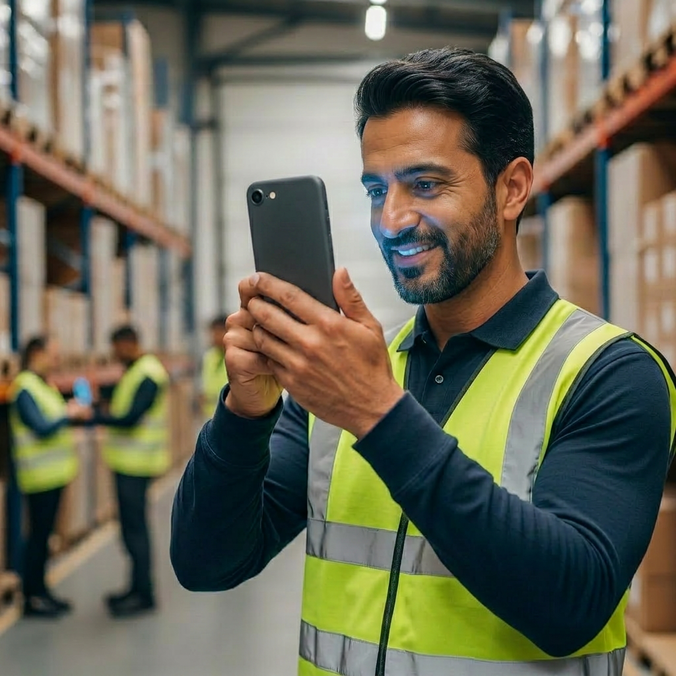
Key Takeaways
Biometric login is no longer a consumer novelty, it is the most practical answer to the credential crisis that defines frontline work today. Shared passwords, sticky notes under keyboards, and forgotten PINs are not minor inconveniences; they are the soft underbelly of enterprise security.
Modern biometric authentication systems are designed to resist the threats that broke passwords, including phishing attacks, credential theft, and password reuse. When implemented well, biometric data never leaves the user's mobile device.
For deskless workforces in particular, biometric login is the difference between a workforce that can actually work and one that spends the first ten minutes of every shift fighting the login process.
A case study from the warehouse floor: when identity becomes the bottleneck
A scenario example: It is 05:45 on a wet Tuesday in Leicester. Murat, a picker at one of Europe's largest logistics operators, is the third person to badge into the distribution center this morning. Before he can pick a single item or scan a single pallet, he has to pass through three separate login screens. The shared floor terminal asks her for a generic depot password, the one written on a laminated card in the shift supervisor's drawer, rotated every ninety days, known by roughly two hundred people. The warehouse management system asks him for a second credential. The safety-briefing portal asks her for a URL nobody can ever remember. By 06:10, Murat has been at work for twenty-five minutes and has done none of the work she came to do.
This was the daily reality across 18,000 warehouse associates at the same operator until last year, when the company moved its entire frontline workforce onto a unified mobile employee platform with biometric login at its core. Murat now begins her shift differently. She opens the work app on her personal phone, glances at the front camera, and is authenticated into every system she needs in under two seconds. The fingerprint scanner on the back of the device handles the days her hands are gloved or dusty. The laminated password card is gone. So is the helpdesk ticket she used to file on the second Monday of every month, when the warehouse system inevitably locked her out.
What changed was not the speed of the warehouse, it was the role of identity inside it. The login process stopped being an obstacle and became a quiet, continuous proof of who was actually doing the work. The same shift is now playing out, with local variations, across logistics yards in Hamburg, hospital wards in Manchester, and food-processing plants in Lyon, and it is the clearest preview we have of what identity verification looks like for the next decade of frontline work.

Reach your operational teams 80% faster and more reliably
Flip's mobile app combines messaging, chat, HR tools, and your knowledge base in one secure application. No additional tools or licenses required.
What biometric login actually is and why the definition matters
Biometric login is a form of authentication that confirms a user's identity using one or more unique biological traits or behavioral characteristics rather than a memorised secret. Where a traditional password asks what do you know?, biometric authentication asks what are you? and, in some newer systems, how do you behave?
The distinction matters because the failure modes are completely different. A password can be guessed, written down, phished, reused across sites, or sold on a forum. A fingerprint cannot be guessed. A face cannot be reused on another account. A typing rhythm cannot be phished in a convincing email.
Biometric authentication technologies fall into two broad families. The first relies on physical biometric traits, including fingerprint recognition, facial recognition, iris scanning, voice recognition, and palm vein patterns. The second, increasingly important family is behavioral biometrics, that is, how you hold your phone, how quickly you swipe, the cadence of your keystrokes, the angle at which you typically glance at the screen. Combining physical and behavioral signals is what specialists mean when they talk about multimodal biometric authentication, and it is where the field is heading fastest.
The most common biometric authentication methods used at work
Not every biometric system is built for the same job. The right authentication method depends on the environment, the device, and the level of assurance required.
Fingerprint authentication remains the workhorse. Almost every modern smartphone ships with a capable fingerprint scanner, which is why fingerprint authentication is, by some distance, the most widely deployed form of biometric login in the workplace. It is fast, cheap to roll out (the sensor is already in the employee's pocket), and well understood by users.
Facial recognition has overtaken fingerprints on premium handsets and is gaining ground in enterprise. Facial recognition systems map dozens of facial features, the distance between the eyes, the depth of the brow, the contour of the jaw, into a mathematical template. For frontline workers wearing gloves, hairnets, or safety equipment that covers the hands, facial recognition is often the more practical option.
Voice recognition captures voice patterns, including pitch, cadence, and timbre, and is particularly useful in call-center and field-service environments where hands-free authentication is genuinely valuable.
Behavioral biometrics sit quietly in the background. The system captures how a user interacts with their device, typing speed, swipe pressure, walking gait if a wearable is involved, and uses these distinct characteristics to flag anomalies in real time. If a malicious actor manages to obtain a valid user's credentials but holds the phone differently, behavioral biometrics can deny entry without a single password prompt.
In serious deployments, these are not used in isolation. Most enterprise biometric authentication systems now combine at least two factors, typically something the user is (a fingerprint or face) and something they have (the registered mobile device itself). This is what multi factor authentication looks like in 2026, and it is what separates a well-designed system from a brittle one.


Romy Wilson
Shift Leader, Ben and Jerry's, Australia and New Zealand
How does miometric login work, in practice?
The mechanics are less mysterious than they sound. When an employee enrolls, the system captures a sample of the chosen biometric trait, say, a fingerprint, and converts it into a mathematical representation. That representation, known as a biometric template, is a one-way transformation: you cannot reconstruct the original biometric data from the template any more than you can reconstruct a song from a hash of its file.
In a properly designed system, the biometric template is stored securely on the user's mobile device, inside a hardware-isolated secure enclave. It never travels to the company's servers. When the user logs in, the device compares the live sample against the stored template locally and, if the match succeeds, releases a set of cryptographic keys that prove to the back-end system that the user is who they claim to be.
This is the architectural choice that makes the difference between a system that protects your workforce and one that becomes a liability. Original biometric data should never sit on a central server. The moment it does, you have created a target that, if breached, cannot be reset. You can issue new complex passwords after a data breach. You cannot, however, issue a new face.
Are biometric authentication systems hackable? An honest answer
The most common question I am asked by IT leaders considering biometric authentication: is biometric authentication hackable?
The honest answer is yes, but rarely, and almost never in the ways the headlines suggest.
The most discussed attack vector is biometric spoofing, sometimes called presentation attacks. A malicious actor presents a photograph, a moulded silicone fingerprint, or a synthetic voice sample to a sensor and tries to fool it. Many biometric systems on the market today, particularly the cheaper consumer variants, are demonstrably vulnerable to well-resourced spoofing attempts. Researchers at Chaos Computer Club famously bypassed early iPhone fingerprint sensors with a high-resolution photograph and woodglue, and have repeated the trick with various biometrics since.
Enterprise-grade systems, however, are built with anti spoofing mechanisms specifically designed to defeat these attacks. Modern facial recognition systems use depth sensing and infrared imaging to verify that they are looking at a living, three-dimensional face rather than a printed photograph. Liveness detection in voice recognition listens for the micro-variations that distinguish a real speaker from a recorded one. Behavioral traits add a second layer that is extraordinarily difficult to replicate, because a malicious actor would have to fake not just the fingerprint but the entire interaction pattern of the legitimate user.
There is also one threat worth naming honestly that has nothing to do with technology. In a small number of jurisdictions, biometric systems have been misused by repressive foreign governments and immigration enforcement agencies in ways that compromise individual privacy. This is a real concern, and a well-designed biometric authentication solution must address it through clear user control, transparent data protection policies, and a strict commitment that biometric information remains on the user's device.
Reach your operational teams 80% faster and more reliably
Flip's mobile app combines messaging, chat, HR tools, and your knowledge base in one secure application. No additional tools or licenses required.
The real benefits of biometric authentication for frontline teams
The benefits of biometric login become most visible when you stop measuring them in IT cost savings and start measuring them in shifts that begin on time.
Enhancing security without burdening users. Traditional authentication methods rely on the user remembering something. The harder you make the password rule, the more likely the user is to reuse it elsewhere or write it down. Biometric authentication breaks this trade-off. A fingerprint cannot be reused on a phishing site because there is no shared secret to reuse. This eliminates one of the largest sources of credential theft in modern enterprise.
A secure and convenient alternative to shared accounts. On many frontline sites, a single shared kiosk login is still the norm because individual credentials are too cumbersome. Biometric login on personal mobile devices ends the shared-account problem entirely. Each shift, each task, each safety acknowledgement is now tied to a specific user's identity.
Resistance to phishing attacks. Passwordless authentication, of which biometric login is the most user-friendly variant, is effectively immune to traditional phishing. There is no credential for an attacker to steal because there is no credential being typed.
Enabling seamless access across multiple systems. A single biometric authentication event can unlock the rota app, the safety portal, the payslip view, and the team chat without further friction. For an employee who clocks in eleven times a week, the cumulative time saved is significant; for an employer measuring engagement, the cumulative goodwill is more significant still.
Fraud detection and stronger identity verification. In sectors where stolen credentials are weaponised against the business, think online banking, retail loss prevention, or any environment where one user can authorise a transaction on behalf of another — biometric systems provide an audit trail tied to a specific human being rather than a guessable string.
A stronger overall security posture. When biometric authentication is combined with device-based cryptographic keys and behavioral biometrics, you are no longer relying on a single line of defense. You have a defense-in-depth model that is genuinely difficult for emerging threats to penetrate.
The limits worth naming: privacy concerns and sensitive data
No serious treatment of this topic can skip the legitimate concerns.
The first is the obvious one: biometric data is, by definition, sensitive data. It identifies a specific human being. It cannot be changed. If it is stored insecurely, the consequences are permanent. Any organization considering biometric authentication solutions must demand a clear architectural answer to the question where does the biometric template live, and who can access it? The correct answer, in 2026, is on the user's mobile device, in a secure enclave, and nobody except the user.
The second is consent and user control. Employees must be free to opt out without being penalised, and they must be able to revoke their enrollment at any time. A biometric login system that does not give the user full control over their own biometric information has no place on a frontline workforce.
The third is data protection compliance. In the EU, biometric data falls under Article 9 of GDPR as a special category of personal data. The legal bar for processing it is high, and rightly so. The good news is that on-device biometric authentication, where the company never receives the underlying biometric data, sidesteps most of the heaviest regulatory burdens, because the company is not, in the legal sense, processing the biometric data at all.
How Frontline Identity reshapes the moment a worker signs in
For frontline-heavy organizations, the practical question is not should we use biometric login? but how do we deploy it across a workforce that has no corporate email address, no fixed laptop, and no patience for IT projects that take a year?
Murat's morning is the argument in miniature. Three login screens, a laminated password card known to two hundred people, and twenty-five minutes gone before the first pallet moves. Frontline Identity by Flip is built to collapse that to the glance the article describes. The worker opens the app on the device in their pocket, a face check or a fingerprint confirms them, and the biometric template never leaves the secure enclave on that device, which is the architectural choice the article rightly insists on.
There is no original biometric sitting on a central server waiting to become a target that cannot be reset. The gloved or dusty hands that defeat a fingerprint fall back to a facial check or a short PIN, so the method bends to the shift rather than the other way round.
A two-second sign-in only pays off if it opens more than a login screen, and this is where the wider platform comes in. Once biometric login verifies the worker, the AI Workflows carries that identity into the safety briefing, the shift swap, and the absence request, so each runs behind one proven sign-in instead of three. Flip Fusion uses the same verified identity to ship purpose-built apps to a site in minutes, such as a pallet-damage log for the loading dock, already authenticated and role-aware.
The AI Agent Gateway lets Ask AI act on the worker's behalf inside connected systems such as SAP, and because every action inherits the biometric-backed identity, the agent is provably the right person rather than a borrowed credential. Ultimately, Biometric login stops being a faster door and becomes the continuous proof of who is doing the work, across everything the shift touches.
How Frontline identity applies on-site
Picture a logistics operator running three distribution centers with 12,000 pickers and packers on rotating shifts. Before biometric login, each associate passed through a shared depot password and two more credentials before touching a single pallet, and the helpdesk fielded a wave of lockout tickets every Monday. With Frontline Identity, an associate like Lena glances at the front camera and is inside every system in under two seconds, with a fingerprint as backup for gloved hands. AI Workflows carries that sign-in into safety briefings and shift swaps, Flip Fusion gives the dock team a pallet-damage log built in an afternoon, and Ask AI checks remaining leave or raises a maintenance ticket through the AI Agent Gateway, all behind the same biometric-backed identity. The first ten minutes of every shift go back to the work, and the laminated password card in the supervisor's drawer never returns.
Reach your operational teams 80% faster and more reliably
Flip's mobile app combines messaging, chat, HR tools, and your knowledge base in one secure application. No additional tools or licenses required.
Why this matters for the future of work, and for Flip as a platform
The reason this conversation is intensifying right now has very little to do with passwords and a great deal to do with artificial intelligence.
As AI agents begin to take real action inside companies, like drafting communications, approving expenses, scheduling shifts, or even initiating workflows on behalf of human employees, the question of who is authorising what becomes existential. An AI that can act in the name of an employee is only safe if the system can verify, with high confidence, which employee actually instructed it. Weak authentication methods are not just a security risk in this world. They are a governance crisis waiting to happen.
This is why a platform like Flip, purpose-built for frontline employees and designed around AI-native workflows, treats identity not as a feature but as a foundation. A single, biometrically-verified identity that follows the employee across every interaction, including communication, HR self-service, task completion, and AI delegation, is what makes the rest of the platform trustworthy. Without it, every clever AI feature on the platform becomes a question mark. With it, the entire system can be entrusted with progressively more responsibility, at the pace that genuinely serves the workforce rather than overwhelms it.
The companies that get this right in the next two years will not be the ones with the most sophisticated AI. They will be the ones whose AI knows, beyond reasonable doubt, who it is working for.
A forward-looking conclusion: the body as the last honest credential
When Eurycleia knelt to wash a stranger's feet, she expected nothing. What she found was a scar above the knee, the mark of a boar's tusk from a hunt long ago, and in that instant she knew Odysseus had come home. No password could have told her that. No name, no clothing, no clever story. The body itself was the proof. Homer called it sēma, and the principle has aged remarkably well.
The next generation of work will be defined less by what we know and more by who we are and how we behave. For frontline employees, who have spent two decades being given the worst tools and the most fragile credentials in the enterprise, biometric login is not a luxury. It is the first form of identity verification that actually fits the texture of their working day. And for the organizations that employ them, it is the foundation on which every AI-era promise, from productivity to autonomy, safety, and trust, will either stand or quietly collapse.
Sources: National Institute of Standards and Technology (NIST), Digital Identity Guidelines: Authentication and Lifecycle Management; Jain, A. K., Ross, A., & Nandakumar, K. (2011). Introduction to Biometrics.
FAQ - Biometric login
When the employee enrolls, the device captures their fingerprint or facial features and converts the data into a mathematical biometric template that is stored securely in a hardware-isolated enclave on the phone itself. At each login, the device matches the live sample against the stored template locally and, if it matches, releases cryptographic keys that prove the user's identity to the back-end system. The original biometric data never leaves the device.
In principle, yes — every authentication method has weaknesses. In practice, modern biometric authentication systems with liveness detection, anti spoofing mechanisms, and on-device template storage are significantly harder to defeat than traditional passwords. The most common real-world attacks (phishing, credential theft, password reuse) do not work against biometric login at all, which is why it is considered a stronger authentication method overall.
A unimodal biometric authentication system uses a single biometric trait. For example, fingerprint authentication only. A multimodal biometric authentication system combines two or more, such as facial recognition plus behavioral biometrics, to provide higher assurance and resistance to spoofing. Most enterprise deployments now use multimodal authentication by default.
Frontline workers typically do not have a corporate email address, a dedicated laptop, or the patience to manage complex passwords across multiple systems. Biometric login on a personal mobile device removes those barriers and replaces them with a login process that takes under two seconds. It also ends the practice of shared-account logins on kiosks, which is one of the largest security weak points in deskless industries.
Reach your operational teams 80% faster and more reliably
Flip's mobile app combines messaging, chat, HR tools, and your knowledge base in one secure application. No additional tools or licenses required.

Dr. Franzi Finkenstein
Dr. Franzi Finkenstein is part of the Content & Search team at Flip, writing about digital communication, employee engagement and AI–human connections. Drawing on a humanities PhD and extensive editorial experience, she focuses on how digital technology is reshaping the future of work and explores how employee health and wellbeing in modern workplaces can be improved.
Don’t forget to share this content

More on the topic of Identity Access Management

AI-First Employee Experience Platform: 2026 Trends & One-Touch
Digital Workplace: how AI is changing everything

Auth0 alternative: honest enterprise guide 2026