






Auth0 alternative: the honest guide for enterprises in 2026
Published:
Every company has one lock that matters more than the rest. For a surprising number of enterprises in 2026, it is not on a server room door at all. It is on a shared tablet bolted to a factory wall, and nobody on the security team has ever seen it.
Long before anyone called it identity and access management, organizations were trying to answer one stubborn question: who gets in, who doesn't, and how do we know? Auth0 made that question easier for developers shipping web and mobile applications.
However, it was never really designed for enterprises whose workforce now spans both office desks and production lines. Searching for an honest Auth0 alternative in 2026 is, in truth, searching for an identity layer that recognizes every employee, including the 2.7 billion who have, until now, lived without a corporate email address. The choice companies make about authentication infrastructure today is the choice they make about who their company will see, trust and empower tomorrow, particularly as biometric login moves from novelty to default. This article is a clear-eyed guide to that choice.
 Dr. Franzi Finkenstein
Key Takeaways
Auth0 alternatives are no longer a niche conversation. Rising licensing fees tied to monthly active users, growing demand for infrastructure control, and frontline workforces that were never part of the original design brief have pushed identity and access management onto the executive agenda, not the IT backlog.
The choice is structural, not cosmetic. Open source authentication solutions such as Keycloak, Authentik or FusionAuth offer infrastructure control and cost efficiency; managed services such as Okta, Microsoft Entra ID or AWS Cognito offer enterprise readiness and operational ease. Picking between them is a decision about where your internal expertise sits, not which login page looks prettiest.
The next era of identity belongs to the frontline. As AI agents start acting on behalf of employees, every authentication decision becomes a question of trust, traceability and access, particularly for the 2.7 billion deskless workers who have, until now, lived outside the world of corporate credentials.
A door, a key, and the people we forgot to let in
In Franz Kafka's The Castle, the land surveyor K. arrives in a village governed by an administration he can see but never quite reach. There is always one more clerk, one more permission, one more locked door between him and the work he was hired to do. The story is not really about a castle. It is about the quiet violence of being denied access by systems that were never built with you in mind.
A century later, that experience is the daily reality of millions of frontline workers.
From Kafka's castle to the shop floor: when identity systems exclude the people they should serve
Consider Marco, a shift supervisor at a mid-sized European packaging plant. His morning begins not on the production line, but in front of a shared tablet bolted to the wall. He needs to clock in, confirm last night's incident report, request a glove reorder, and check whether his colleague on parental leave has signed off the shift swap. Each of these tasks lives behind a different login. None of them remember him. By the time he reaches the floor, he has lost eight minutes, and a small but real piece of his goodwill toward the company.
Avery Dennison, the global materials science manufacturer, faced exactly this pattern at scale. Across roughly 35,000 frontline workers, shared devices, forgotten passwords and repeated logins ate measurable hours from each shift. Their response, a passwordless authentication program built on badge taps, QR codes and biometrics, with Okta and a frontline identity layer in the middle, gave every operative one credential that worked across payroll, benefits and job instructions on shared tablets. It was not a UX project. It was an operational rebuild of who the company recognized as a user.
This is the real reason the search volume for alternatives to Auth0 has climbed steadily for three years. Auth0 is an excellent product for web and mobile applications built around named, desk-based, email-having users. But enterprises are no longer just that. They are factories, retail floors, distribution centers and construction sites. The identity layer they need has to recognize everyone, not just the people with a laptop and a corporate inbox.
The question, then, is not "which login looks slickest?" It is closer to the one K. could never get answered: Who, exactly, gets through the door, and on what terms?
If identity and access management is the architecture of trust inside your organization, and biometric login is one of its newest doorways, then choosing the right authentication infrastructure is one of the most consequential decisions a company will make this decade. Why do so many enterprises now treat that choice as urgent?
How to compare features fairly: protocol support, multi factor authentication and enterprise readiness
Before naming names, it is worth being precise about what "enterprise readiness" really means in identity. The vendor decks are noisy. The truth is narrower.
A serious access management solution for an enterprise environment in 2026 should offer:
Comprehensive protocol support — OpenID Connect, OAuth 2.0, SAML 2.0, SCIM, and ideally FIDO2/WebAuthn for modern passwordless authentication.
Multi factor authentication that is not bolted on, with native support for TOTP, push notifications, hardware keys and biometrics across web apps, mobile apps and shared devices.
Flexible deployment options — multiple deployment models including managed services, private cloud, and self hosted deployment for organizations with strict infrastructure control requirements.
Enterprise SSO for both employee-facing identity providers (Active Directory, Entra ID, Google Workspace) and external identities (customers, partners, contractors).
Sophisticated user management — user provisioning, user federation, organization management, multi tenant support, and granular audit logs that satisfy compliance teams without requiring custom engineering.
Fine grained authorization beyond basic role-based access control — relationship-based, attribute-based, and increasingly, context-aware policies that account for device, location, and risk signals.
Visual workflows for authentication flows so that login flows, MFA step-ups and recovery paths can be modified without rewriting code each time the security team changes its mind.
Admin console, API gateway integration, fraud detection and session management that work together rather than as four disconnected products.
Enterprise grade security with documented certifications (ISO 27001, SOC 2, HIPAA where relevant) and a clear stance on incident response.
The thing is, however, no single product wins on every dimension. The honest comparison is about which trade-offs you are willing to make, between cost efficiency and managed services, between infrastructure control and internal expertise, between feature restrictions and customization freedom.
This lens makes the rest of this guide useful.
The strongest alternatives to Auth0, grouped by what they actually optimize for
The market has fragmented into three honest camps. Naming them clearly is more useful than ranking products one to ten.
Open source identity platforms and self hosted alternatives: maximum control, demanding ownership
This is the category that has grown fastest. Keycloak, originally a Red Hat project and now under the CNCF umbrella, remains the gravitational center. It offers a comprehensive feature set, OpenID Connect, SAML, social logins, user federation with Active Directory and LDAP, fine grained authorization, multi tenant support, without licensing fees. Authentik has emerged as a more modern, opinionated alternative with strong visual workflows and a cleaner admin console. FusionAuth sits in the middle ground: an open core model, generous free tier, and a strong reputation for developer ergonomics. Ory (with Kratos, Hydra and Keto) is the most modular: best for engineering teams who want to assemble their own stack rather than buy one.
What you gain: full control over authentication infrastructure, self hosted deployment, no per-MAU pricing, an active community, and the freedom to extend authentication flows however you wish.
What you give up: managed services. You are responsible for uptime, patching, scaling, and security hardening. The community support is real and often excellent, but it is not a 24/7 enterprise support contract. Internal expertise becomes a hard requirement, not a nice-to-have.
For organizations with mature platform engineering teams, and a genuine reason to keep identity in-house, these open source alternatives are, in many cases, the better choice. For everyone else, they are a slow-motion trap.
Enterprise identity providers: full service, full price, and built-in authentication flows
Microsoft Entra ID (formerly Azure AD) is the default for any organization already deep in the Microsoft ecosystem. Tight integration with Active Directory, Office 365, and increasingly with Microsoft Copilot makes it a difficult option to bypass. Okta Workforce Identity is the pure-play category leader: arguably the most polished admin console, the broadest catalog of pre-built integrations, and the most mature approach to enterprise SSO and user provisioning. Ping Identity continues to be the strong choice for large, regulated enterprises with complex federation requirements.
These platforms are designed for enterprises that want to manage users, not authentication code. They handle modern authentication, multi factor authentication, passwordless login, session management and audit logs out of the box. Their advanced features and support options are genuinely enterprise grade.
The trade-off is the one you would expect: licensing fees, less infrastructure control, and limited customization beyond what the product team has decided to expose. For most organizations above 1,000 employees, that trade-off is still the right one, provided the per-seat economics make sense.
Cloud-native and developer-first platforms: built for specific shapes of work
AWS Cognito is the natural choice when an application is already running on AWS and needs to integrate with other AWS services such as API Gateway, Lambda and IAM. It is rarely the answer for a workforce-wide identity strategy, but for customer-facing web and mobile applications inside an AWS estate, it is genuinely cost-effective. WorkOS is purpose-built for B2B SaaS products that need to implement passwordless login, enterprise SSO and SCIM provisioning for their own customers, a different problem from workforce identity. Stytch, Frontegg and SuperTokens occupy related niches: each offers strong developer ergonomics, a focus on modern authentication flows and faster time-to-implementation than the legacy options.
These are excellent products. They are not, however, comprehensive enterprise identity providers, and confusing the two is one of the most expensive mistakes a procurement team can make.
Compare features at a glance: open source alternatives vs. managed Auth0 alternatives
| Dimension | Open source identity (Keycloak, Authentik, FusionAuth) | Enterprise identity providers (Okta, Entra ID, Ping) | Cloud-native platforms (Cognito, WorkOS, Stytch) |
|---|---|---|---|
| Deployment | Self hosted, private cloud | Managed services | Managed, cloud-native |
| Licensing fees | None / minimal | High, per-MAU | Moderate, per-MAU |
| Infrastructure control | Full | Limited | Limited |
| Enterprise SSO & MFA | Strong | Strongest | Variable |
| Best fit | Mature platform teams | Large enterprises | B2B or AWS-native use cases |
The honest reading: there is no single winner. There is only the right match between your internal expertise, your authentication costs, your deployment preferences and the shape of your workforce.
The frontline question almost nobody asks during an identity RFP
Here is the gap that most evaluations miss.
When a procurement team compares Auth0 alternatives, the conversation tends to revolve around developers, customers and office employees. The single sign on demo flows through Salesforce. The MFA demo runs on a knowledge worker's phone. The audit log shows a compliance officer logging in from a corporate laptop.
But for an enterprise in manufacturing, retail, logistics or construction, the largest user group is none of those people. It is the operative on the floor, the person without a corporate email address, without a personal company device, often without a stable internet connection during the workday. The Imprivata/Ponemon 2024 study found that frontline organizations lose 872 hours every week to device-related authentication disruptions, costing roughly $1.4 million per year per organization. Fifty-four percent had experienced breaches tied to shared credentials. This is a structural blind spot.
Most Auth0 alternatives, including the strongest open source identity platforms and the most mature enterprise identity providers, were designed for users who exist in directory services to begin with. They do not have a clean answer for the 5:42am question: how does Marco log into a shared tablet, identify himself uniquely, complete his shift confirmation, and step away, without remembering a password, without compromising audit logs, and without slowing the line?
The companies winning on this question are the ones treating frontline identity as a first-class category, not an afterthought. Avery Dennison's badge-tap and QR-based approach is one model. Biometric login on shared devices is another. The pattern that ties them together: identity is being designed for the shift, not retrofitted from a developer SDK.
This is exactly the gap that Frontline Identity is built to close.
Why a frontline-first identity layer sees the workers Auth0 was built to miss
The article lands on an honest verdict. Auth0 is an excellent product for named, desk-based, email-having users, and it was never designed for a workforce that now spans production lines, retail floors, and construction sites.
Frontline Identity fills exactly that absence. It gives Marco, the supervisor stuck in front of a shared wall-mounted tablet, one credential that works across payroll, benefits, and job instructions, opened by a badge tap, a QR code, or a biometric check rather than yet another login that fails to remember him. It does not compete with Auth0, Okta, or Entra for the desk-based staff those tools serve well. It sits alongside them and extends recognition to the 2.7 billion deskless people the article keeps in view, so the identity layer finally sees everyone the enterprise employs.
That recognition becomes valuable the moment a worker tries to act, which is where the rest of the platform comes in. The AI Workflows turns the everyday tasks that used to stall behind a login into processes that simply run behind Marco's verified identity. His incident sign-off routes straight to the safety lead, his glove reorder reaches the right approver, and a shift swap with his colleague on parental leave closes itself once both sides confirm, all without a single extra password prompt.
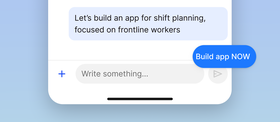
Flip Fusion then covers the niche needs a developer-first tool would never reach the bottom of its backlog for. A plant like Marco's could describe a machine-fault log, a glove-and-PPE stock tracker, or a daily line-changeover checklist in plain language and have a working app on the shared tablets within minutes, governed and authenticated from its first screen.
Complementarily, the AI Agent Gateway is where the article's closing point about AI agents becomes concrete. When Ask AI checks Marco's remaining leave in Workday, raises a maintenance ticket in Jira, or pulls the latest packaging spec from SAP, it acts with his exact permissions, so every step stays traceable to a real, verified person.
The choice of authentication infrastructure, as the article puts it, is a choice about who the company will see and empower, and a frontline-first identity layer answers that question for the half of the workforce most platforms still overlook.
How does Frontline identity apply on-site? Consider a packaging group with 35,000 operatives spread across plants in several countries, all sharing wall-mounted tablets. Auth0 keeps the developer-built customer and office apps running smoothly, yet the operatives themselves have no real identity, so a supervisor like Marco loses minutes each morning to logins that never remember him. Adding Frontline Identity alongside the existing stack gives every operative one credential that opens payroll, benefits, and job instructions through a badge tap or a biometric check. AI Workflows runs Marco's incident sign-offs and reorder requests behind that identity, Flip Fusion lets each site build a line-changeover checklist without waiting on a developer backlog, and Ask AI completes tasks in Workday or raises a ticket in Jira through the AI Agent Gateway with his exact permissions.
Auth0 still serves the people it was built for, and the 35,000 it was not are finally recognized, traceable, and trusted.

Reach your operational teams 80% faster and more reliably
Flip's mobile app combines messaging, chat, HR tools, and your knowledge base in one secure application. No additional tools or licenses required.
Why this choice shapes the next decade of work, not just the next budget cycle
Identity used to be a back-office function. In 2026, it is becoming the most consequential infrastructure decision a company makes, for one reason: AI.
When AI agents begin acting on behalf of employees, like booking shifts, processing absence requests, retrieving payslip data, every action requires an authenticated identity. Not just a user logged in, but a verifiable chain from human to agent to system. Without it, audit logs collapse into noise, and agentic AI in the enterprise turns into a compliance nightmare.
The platform you pick today is the substrate on which AI will or will not work safely tomorrow. It is the difference between AI that augments your workforce and AI that quietly corrodes trust in it, particularly for the frontline, who will increasingly meet their employer through an AI interface.
That is the real meaning of an Auth0 alternative in 2026. It is not a cheaper login. It is a more honest one.
Sources: Verizon, 2024 Data Breach Investigations Report; IBM Security & Ponemon Institute, Cost of a Data Breach Report 2024; Franz Kafka,The Castle ,1926.
FAQ - Auth0 alternative
There is no single best option, but enterprises with large deskless workforces should look beyond traditional identity providers. The strongest setups in 2026 combine an enterprise-grade access management solution (such as Okta, Microsoft Entra ID or Keycloak) with a frontline-specific identity layer that supports passwordless login on shared devices, biometric login, and one-touch access to operational apps. The frontline use case is rarely solved by general-purpose web and mobile authentication tools alone.
Yes, but with conditions. Keycloak, Authentik, FusionAuth and Ory are all mature open source identity platforms with comprehensive feature sets — OpenID Connect, SAML, user federation, multi factor authentication, fine grained authorization. The question is not whether the software is enterprise-ready, but whether your organization has the internal expertise to operate it as a critical system. Without a dedicated platform team, the cost efficiency advantage often disappears once you account for uptime, patching and security operations.
Savings vary widely. Organizations switching from Auth0 to a self hosted deployment of Keycloak typically eliminate licensing fees entirely, but add infrastructure and engineering costs. Organizations switching to Microsoft Entra ID often save through bundled Microsoft 365 licensing. Organizations switching to AWS Cognito save by tightening integration with other AWS services. The honest answer is that switching is rarely a pure cost-cutting move — it is a strategic shift in what you control and what you outsource.
No. Flip Identity is not a general-purpose customer or B2B identity platform. It is the digital identity layer for the frontline workforce inside Flip's employee experience platform — designed to integrate with, rather than replace, enterprise SSO and identity and access management solutions you already use.
Reach your operational teams 80% faster and more reliably
Flip's mobile app combines messaging, chat, HR tools, and your knowledge base in one secure application. No additional tools or licenses required.

Dr. Franzi Finkenstein
Dr. Franzi Finkenstein is part of the Content & Search team at Flip, writing about digital communication, employee engagement and AI–human connections. Drawing on a humanities PhD and extensive editorial experience, she focuses on how digital technology is reshaping the future of work and explores how employee health and wellbeing in modern workplaces can be improved.
Don’t forget to share this content

More on the topic of Identity Access Management

AI-First Employee Experience Platform: 2026 Trends & One-Touch

What should an Employee Engagement App do in 2026?

What is a Frontline App? Guide for deskless teams in 2026