






Frontline App: What it is and how it works for deskless teams in 2026
Published:
What happens when 80% of the global workforce has no desk, no corporate email, and no access to the systems that run their organization? For decades, the answer was: nothing. Enterprise software was primarily built for office workers. Frontline employees were expected to make do with noticeboards, word of mouth, and paper rosters.
A frontline app changes that equation entirely. Built as a mobile first, AI native employee engagement platform, it puts communications, HR services, scheduling, and real time AI tools directly into the hands of the people who need them most. This guide breaks down what a frontline app is, what it does, and why choosing the right one in 2026 is no longer a nice to have but a business critical decision.
 Dr. Franzi Finkenstein
Key Takeaways
A frontline app is a mobile first digital workplace built for employees without a desk, a corporate email, or reliable desktop access. It brings communications, HR services, scheduling, knowledge bases, and security into a single platform.
Most enterprise software was never designed for frontline workers. That is a structural failure that drives disengagement and quiet quitting at scale.
AI in a frontline app enhances operational efficiency by automating repetitive tasks, analyzing operational data in real time, and surfacing knowledge base content on demand.
Recognition and access are linked. Flip AI's research found that 88% of frontline workers who feel appreciated go the extra mile. A frontline app is the mechanism through which that recognition reaches them.
Digital transformation for frontline organizations starts with data. The analytics a frontline app generates, from adoption rates to task completion patterns, give leaders the evidence they need to optimize processes and make better decisions.
What Is A Frontline App? - Connecting the Disconnected
In short: A frontline app is a mobile first digital platform that connects deskless employees to company communications, HR self service, shift scheduling, knowledge bases, and team collaboration without requiring a corporate email address or a desktop computer. It is the foundation of any digital transformation strategy for organizations with frontline workers.
In January 2026, McKinsey published a finding that should have kept every operations leader awake: US companies spent more than $1 trillion on IT last year, including hundreds of billions on AI, yet over 60% reported no significant bottom-line impact. The reason was not the technology. It was the people the technology was never built for. The frontline workforce, roughly 100 million Americans who make, move, sell, and serve, remains the largest segment of the economy and the least digitally equipped.
Flip AI's own research tells a similar story from the other side. In From Unsung Heroes to Quiet Quitters: The State of the Frontline Today, one in five UK frontline workers admitted to doing the bare minimum to keep their jobs. This has less to do with laziness than with what happens when people feel invisible for long enough. 61% experience stress or burnout at least once a month. Only 43% feel appreciated. The tools they were given never worked for the lives they actually lead.
A frontline app is the answer to both problems, not as a consolation prize for workers without desktops, but as infrastructure built from the ground up for how frontline work actually happens.
No corporate email. No desktop dependency. No assumption that work happens at a desk.
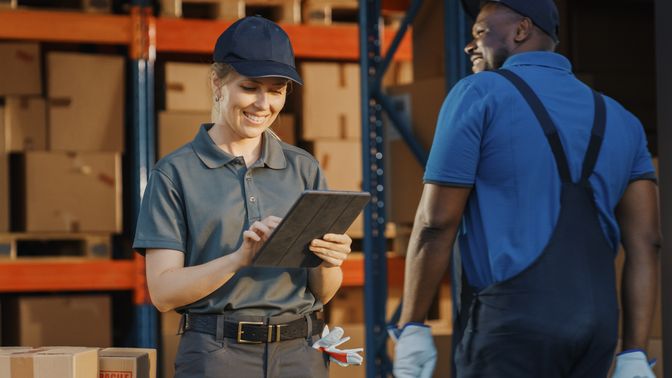
Frontline worker engaged in daily business via an AI-native frontline app.
What Does A Frontline Mobile App Actually Do?
Most frontline apps focus on bridging the gap between employees in the field and office based teams. They bring together communication, workforce management, self service HR, training, and operational tools in a single mobile platform that works for people who are rarely at a screen.
Employees receive push notifications for company news, check leave balances, submit absence requests, and complete task checklists, all from their phone. Managers can approve leave, update rosters, and track who has seen critical updates through read receipts. QR code sign in removes the need for a corporate email address, which remains the single biggest barrier to digital access for deskless workers.
A built in knowledge base gives employees instant access to SOPs, training materials, safety protocols, and company policies. Rather than searching shared drives or waiting for a manager, frontline workers can find the answer they need in seconds. For organizations pursuing a digital transformation strategy, this shift from paper based information sharing to structured, searchable knowledge is one of the highest impact changes a frontline mobile app delivers.
Automated workflows replace manual processes for tasks such as absence approvals, shift swaps, and compliance sign offs. This improves accuracy and consistency, minimizes human error, and ensures that regulatory requirements are met without relying on paper trails or individual memory.
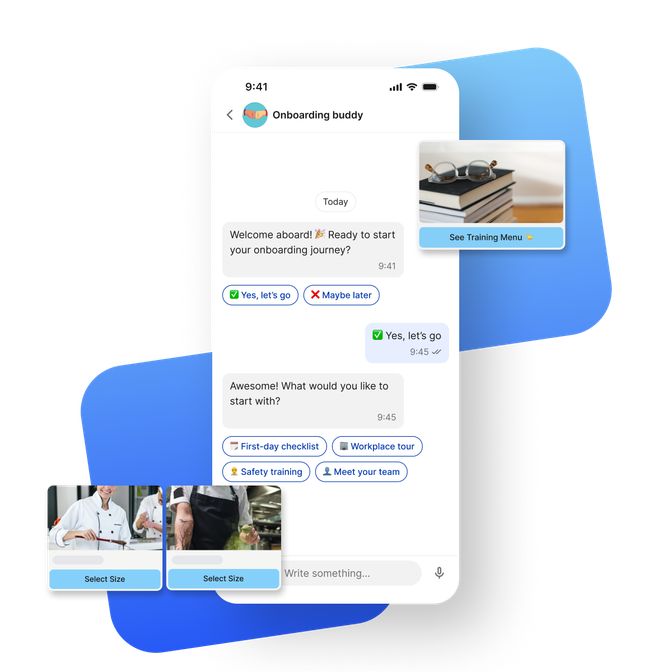
Discover how Flip AI empowers different roles across your organization — from communications to HR to operations here.
Frontline Is A Community, Not Just A Platform
Flip AI's research found that only 43% of UK frontline workers feel appreciated. But of those who do, 88% said they feel motivated to go the extra mile. That is four times the rate of those who feel unappreciated.
The implication of this finding is not subtle. Recognition drives effort. And effort, at scale, drives productivity. Frontline is a community outcome as much as it is a technology choice. When employees across shifts, sites, and regions can communicate, share feedback, and access the same information, an organization starts to function as a connected whole rather than a collection of disconnected teams.
Frontline workers are often the first point of contact with customers. Their engagement directly shapes service quality, customer satisfaction, and operational performance. When these employees feel informed and valued, the impact reaches far beyond the break room. It shows up in how they interact with customers, how quickly they resolve problems, and how willing they are to go beyond what is strictly required.
Why Engaging Frontline Workers Requires A Different Strategy
The deskless nature of frontline work creates communication challenges that office based strategies simply cannot address. These employees do not check email. They do not sit through webinars. They do not browse an intranet between meetings. Any communication strategy that assumes otherwise will fail before it starts.
Effective frontline engagement means meeting workers where they are: on their phones, between tasks, in their own language. It means targeted push notifications segmented by shift, location, and role rather than company wide emails that reach 10% of the workforce. It means two way channels where employees can respond, ask questions, and share feedback rather than passive top down broadcasts.
The organizations that get this right do inform their workers and include them in daily communication. And that inclusion, delivered consistently through a platform built for deskless work, is what turns a disengaged workforce into one that actively contributes to the business.
Why Every Frontline App Is A Community Project
Deploying a frontline app is, at its best, a community project. Not a technology rollout. Not an IT ticket. A deliberate act of inclusion that brings HR, operations, internal communications, and the frontline teams themselves around the same table before a single notification is ever sent. The organizations that understand this do not just achieve adoption. They build ownership.
That ownership is what you see when Marco, a store team lead, opens the app at 6:45 a.m. before the shop floor lights come on. He checks an overnight product recall alert, sends shift updates to three colleagues, and confirms weekend compliance training is complete. No desktop, no email, no phone call to head office. None of this happened because someone in IT installed software on his device. It happened because Marco's team was involved from day one, shaping the rollout, choosing the use cases, and making the app their own. Technology adopted without community is software. Technology adopted with community becomes infrastructure.
Margarete Dinger
Source: Head of Content Hub, MAHLE
How Does AI In A Frontline App Enhance Operational Efficiency?
McKinsey's 2026 research is direct: investing in AI without equipping the workforce to use it produces no measurable return. For frontline organizations, this means AI must be embedded where employees already work, inside the frontline app itself.
AI in a frontline app enhances operational efficiency in three concrete ways. First, it automates repetitive tasks such as absence requests, shift swaps, and approval workflows, freeing managers to focus on their teams rather than admin. Second, it surfaces knowledge base content through natural language queries, so a warehouse worker can ask "what is the forklift safety protocol?" and get an answer in seconds rather than searching a shared drive. Third, it translates and localises content automatically for multilingual workforces, removing one of the most persistent barriers to effective frontline communication.
Beyond task automation, AI analyses operational data in real time. It can identify patterns in absence rates, flag compliance gaps before they become incidents, and surface adoption trends that tell leaders which teams need support. This is the practical side of digital transformation: a system that turns frontline data into actionable decisions every day.
What Security Measures Does A Frontline App Need?
Data protection is non negotiable. A frontline app handles sensitive employee information including personal data, payslips, health records, and shift patterns. The platform must meet the security standards that regulated industries require.
Essential security measures for any employee app include SSO integration, role based access controls, end to end encryption for messaging, GDPR compliance (or equivalent regional data protection standards), and secure authentication methods such as biometric login or multi factor authentication. For organizations in healthcare, manufacturing, or the public sector, the platform should also support data residency requirements and provide audit trails for compliance reporting.
Local Health And Wellbeing Services In A Frontline App
When 61% of frontline workers experience burnout at least once a month, connecting them to local health and wellbeing support is urgent.
Health and wellbeing services integration is a non-negotiable feature for any serious frontline platform. Employees should be able to reach employee assistance programs, local health resources, and mental health support directly through the app, without having to navigate a separate portal, remember a different login, or ask a manager for a phone number they may not have.
The effects of getting this right are not marginal. Workers who can access mental health support early, before exhaustion tips into breakdown, take fewer unplanned sick days, perform more consistently, and stay longer in their roles. For organizations operating at the thin staffing margins that define most frontline environments, that is not a wellbeing metric. It is a operational one.
For healthcare support workers, porters, cleaners, and care assistants who move between sites, the barriers are structural rather than motivational. They often lack a fixed desk, a permanent line manager in proximity, or reliable access to intranet systems. When support services are embedded in the same app they use to read shift updates and communicate with their team, the friction disappears. What felt inaccessible becomes a tap away.
The difference that makes is transformative. Early access to counseling or an EAP referral can interrupt a deteriorating mental health situation before it escalates into extended absence. Connecting a worker to a local GP registration service or occupational health resource at the moment they need it, rather than three weeks later when they finally speak to HR, changes outcomes. For healthcare support workers in particular, who are exposed to emotionally demanding environments with comparatively little institutional recognition, consistent access to local health and wellbeing services through a single platform can make the difference between early intervention and a crisis that goes unnoticed.
The platform that treats this as a feature tick misses the point entirely. The one that builds it thoughtfully, surfacing the right resource at the right moment, in the right language, without bureaucratic friction, becomes something closer to infrastructure than software.
Frontline Education: Use Cases Beyond The Factory Floor
In the frontline education sector, a dedicated mobile app allows school administrators, substitute teachers, and support staff to manage absences, check leave balances, and receive district updates from their phone. Districts can track absence data across multiple sites and update staff in real time.
Frontline education is a growing segment precisely because the workforce is dispersed, shift based, and underserved by traditional enterprise tools. The same logic that makes a frontline app essential in retail and manufacturing applies in schools where support staff have no desk, no corporate email, and no time to check an intranet.
Frontline App Contact Details And Support That Scales
One overlooked factor in choosing a frontline app is what happens after rollout. Can employees easily find frontline app contact details for IT or HR support? Is there a built in help function, or do workers need to search for a phone number on a shared drive?
The best platforms make frontline app contact details accessible inside the app itself, so employees can reach the right person in one tap. For organizations with high turnover and multiple sites, this means local support during rollout, clearly visible frontline app contact details within the platform, and analytics that show where adoption is stalling.
Why Flip AI Is Purpose Built For The Frontline
Flip AI is a frontline employee experience platform designed from the ground up for workers without a desk. It is not a corporate intranet with a mobile skin.
Comms delivers news, channels, chats, and a knowledge base designed for speed. Employees sign in via QR code or mobile number. No corporate email required.
Flows moves beyond communication into workflow automation. Absence requests, shift confirmations, and HR approvals happen inside the app. Automated workflows ensure accuracy, consistency, and regulatory compliance without manual intervention.
Mini Apps provide deep, native integrations with Workday, SAP SuccessFactors, and UKG. Payslips, shift management, and time tracking work directly in Flip AI, not through middleware.
Ask AI executes tasks through a conversational interface: completing workflows, retrieving knowledge base content, analyzing operational data, and automating repetitive work on the frontline worker's phone, in their language.
Frontline Identity gives every frontline worker a single digital credential with multi factor authentication. One login. One app. One touch access to every system they need, with enterprise grade security built in.
For organizations with 1,000 or more employees across multiple sites, Flip AI provides the analytics, compliance tools, and scalability that a serious digital transformation strategy requires. Adoption rates, task completion data, message read rates, and absence patterns are all visible at team, site, or regional level, giving leaders the data they need to optimize processes and make informed decisions.
Field Note: What It Looks Like When It All Comes Together
It is 5:52 a.m. in a distribution center outside Brighton. A shift supervisor named Adanna opens Flip AI on her phone while waiting for the morning briefing to start. Three things happen in under two minutes.
First, a push notification tells her that a cold chain compliance check is overdue on Dock 7. She taps it, opens the checklist, and assigns it to a colleague who is already on site. The task lands on his phone before Adanna has put hers back in her pocket.
Second, she notices a new starter on today's roster whom she has not met. She types "onboarding checklist for new warehouse operative" into Ask AI. The system pulls the relevant documents from the knowledge base, confirms that the new starter's safety induction was completed yesterday, and flags that his PPE sign off is still outstanding. Adanna forwards the reminder directly to the team channel for Dock 7.
Third, a message from head office lands in her feed: a change to the returns handling process starting next week. It is available in English, Polish, and Romanian, automatically translated for her multilingual team. She taps "confirm read" so her area manager can see the update has reached her shift. The three colleagues who have not yet opened the notification will get a follow up reminder at the start of their next shift.
Adanna handled all of it from her phone. The knowledge base query, the compliance workflow, the AI-generated answer, the translation, the message to her team. A sequence that once would have meant a walk to the back office and a call to HR, resolved in minutes, on the floor.
That is the promise of an AI-native frontline platform: a system that moves at the speed of the work itself.
Adanna is not a power user. She is not technically trained. She is a shift supervisor who needs things to work fast, work simply, and work in the 90 seconds she has before her team arrives. That is exactly what a frontline app built on an AI native platform is designed to do.
The break room noticeboard is still on the wall behind her. Nobody has looked at it in months.
Sources: Flip AI, From Unsung Heroes to Quiet Quitters: The State of the Frontline Today; McKinsey, A US productivity unlock: Investing in frontline workers’ AI skills.

Reach your operational teams 80% faster and more reliably
Flip AI's mobile app combines messaging, chat, HR tools, and your knowledge base in one secure application. No additional tools or licenses required.

Dr. Franzi Finkenstein
Dr. Franzi Finkenstein is part of the Content & Search team at Flip AI, writing about digital communication, employee engagement and AI–human connections. Drawing on a humanities PhD and extensive editorial experience, she focuses on how digital technology is reshaping the future of work and explores how employee health and wellbeing in modern workplaces can be improved.
Don’t forget to share this content

More on the topic of Employee app

Employee app: 10 best tools for internal communication 2025

Essential Workforce Management Tools for Team Optimization
How AI agents will transform the frontline employee experience