






What Employee Engagement App features actually matter in 2026?
Published:
When did your frontline employees last hear important news directly from the organization, rather than a colleague in the break room? For most businesses, the honest answer reveals a communication structure that was never designed with frontline teams in mind.
Disengagement is draining billions from businesses each year, yet most platforms being rolled out were built for desk-based employees and stretched to cover everyone else. For frontline workers, that compromise shows. This guide breaks down what effective employee engagement actually requires in 2026: what frontline teams need and rarely get, how the right platform changes day-to-day operations, and what an AI-native employee engagement app built from the ground up for frontline workers genuinely delivers.
 Dr. Franzi Finkenstein
Key Takeaways
The best employee engagement apps in 2026 are mobile-first, AI-powered, and purpose-built for the realities of frontline employees, not retrofitted from desk-based tools.
Features like pulse surveys, anonymous feedback, recognition tools, and multilingual support have moved from nice to have to non-negotiable for diverse, distributed teams.
Measuring employee engagement inside the app requires more than survey data: advanced analytics and real-time feedback give managers and leadership the actionable insights they need to act quickly and confidently.
The right engagement app does more than improve morale. It reduces high turnover, accelerates employee onboarding, and builds company culture that holds across every role, site, and time zone.
When choosing an employee engagement app, the deciding factor is whether the platform works as a genuine central hub. It offers a single place where every employee can access communication, recognition, HR processes, and their colleagues without switching between tools.
What Is an Employee Engagement App? A Direct Answer for 2026
Picture this scenario: a REWE warehouse operative clocks in at 6 a.m., opens one app, and instantly sees their shift briefing, a recognition note from their team lead, and a response to the feedback they left last week. This happens all before they've pulled on their gloves. No logins. No hunting through intranet pages. No wondering whether anyone read what they wrote.
That's the bar that defines the best employee engagement apps in 2026. It also alerts to the gap between companies that have cleared it and those still relying on notice boards and email chains is showing up in hard numbers: turnover rates, productivity output, and the kind of company culture that either keeps people or quietly drives them out the door.
An employee engagement app is a mobile platform that brings communication, recognition, feedback, and HR processes into one place, so that every employee, regardless of role, location, or working pattern, can stay connected, informed, and heard. In its most basic form, it is a tool for reducing the gap between an organization and its people. At its best, it becomes the digital workplace itself: the single environment through which employees experience their employer each day.
In 2026, the definition of engagement has broadened considerably. Engagement is no longer only about sentiment or wellbeing, though both remain important. It encompasses whether employees can do their job efficiently, access information without friction, receive recognition in meaningful ways, and trust that their voice carries weight. Any employee engagement app that falls short on these dimensions will score well on demos and struggle in deployment.
The Features Every Best Employee Engagement App Must Have
What separates the best employee engagement app from a mediocre one is not the length of its feature list. It is whether those features work together in a coherent, intuitive experience that employees actually want to open. In 2026, the baseline is high, and the following capabilities are no longer optional for any serious platform.
Mobile-First Design and Easy Access
The majority of the world's workforce does not sit at a desk. Frontline employees work on shop floors, in distribution centers, on construction sites, and along logistics routes. For these workers, a platform that was designed for desktop and adapted for mobile is effectively no platform at all. Mobile-first design is the starting point for a credible employee engagement app, and it shapes every decision from navigation to notification logic.
The best employee engagement mobile apps load quickly on older devices and bring the most relevant information within immediate reach. Shift schedules, team news, HR tasks, and messages from managers should all surface without effort. Easy access is the condition on which adoption depends. For frontline employees who have seconds rather than minutes between tasks, it is the condition on which adoption depends. An employee app that requires four taps to find a payslip or three screens to submit an absence request will lose users before it has the chance to engage them.
Push notifications are a critical mechanism here. They bridge the gap between an organization's communications and an employee's attention, ensuring that important updates reach people immediately rather than waiting to be discovered. When notifications are personalized and relevant rather than generic and constant, they become a valued part of the daily rhythm — a quiet signal that the organization is present and communicative.
Internal Communication as a Non-Negotiable Foundation
Every effective employee engagement app is built on a foundation of strong internal communication. Without it, no other feature operates as it should. Employees who do not reliably receive company news, leadership updates, or team communications will not feel engaged, regardless of how sophisticated the recognition or feedback features might be.
The communication capabilities that matter most in an engagement app include structured news feeds that serve content at the right level of specificity, topic-based channels for different teams and locations, direct and group messaging for peer-to-peer connection, and broadcast tools that allow leadership to reach the entire workforce simultaneously. Read receipts and engagement metrics give managers and communications teams visibility into whether their messages are actually landing.
Strong internal communication also means opening the channel in both directions. Employees should be able to comment on announcements, react to posts, and ask questions without needing to find a manager in person. This creates a continuous sense of dialogue that is foundational to genuine engagement, and it sends the signal, repeatedly and implicitly, that employees are participants in the organization rather than recipients of it.
Recognition Tools, Rewards, and Public Shout-Outs
Recognition is one of the most consistently underestimated drivers of employee engagement. Research from Gallup shows that employees who receive regular recognition are significantly more productive, considerably more likely to stay, and more likely to report strong relationships with their peers. Yet in most organizations, recognition still depends on whether a manager remembers to say something at the right moment. This makes it inconsistent, invisible to the broader workforce, and largely unscalable.
An employee engagement app addresses this by building recognition tools directly into the daily flow of work. Public shout-outs let colleagues and managers celebrate contributions openly, creating a visible record of appreciation that goes beyond the immediate moment. Points-based rewards give recognition a tangible dimension that reinforces behavior and makes employees feel that their effort has been noticed. And because all of this happens within the same platform employees use for communication and HR tasks, recognition becomes a natural part of work rather than an awkward, scheduled event.
For frontline workers in particular, recognition tools carry an outsized impact. These employees often work far from headquarters and rarely interact with senior leadership in any direct way. The ability to receive a public shout-out from a colleague in another region, or to be recognized by a manager they have met only once, closes a distance that annual awards ceremonies and performance reviews never have.
Pulse Surveys, Polls, and Anonymous Feedback
Organizations that rely on annual engagement surveys are working with data that is already months old by the time it arrives. The moments that shaped employee sentiment, a poor experience with a manager, a difficult operational change, a company values decision that did not land well, have already passed. Pulse surveys change this by providing a continuous, lightweight feedback mechanism that gives leadership a current read on how employees feel and where attention is needed.
The best employee engagement apps make surveys and polls fast to create and even faster to complete. Employees should be able to respond in seconds from their mobile device. Managers should receive results in real time, with enough context to act rather than just observe. And the data should be structured in a way that makes the implications clear, not just percentage scores, but directional signals that point toward specific decisions.
Anonymous feedback deserves particular attention. In organizations where employees may feel cautious about raising concerns openly, the option to respond without attribution is not just useful — it is often the only way to access the truth. When employees know their responses are genuinely confidential, the quality and candour of feedback improves substantially. An engagement app that offers robust anonymity, with transparent communication about how data is stored and used, builds the kind of trust that makes the feedback worth having.
Multilingual Support for Global, Remote, and Distributed Teams
An employee engagement app that operates only in one language is a communication barrier wearing the costume of a communication tool. For organizations with global teams, diverse workforces, or employees whose first language differs from the organization's primary one, multilingual support is not an enhancement. It is a requirement.
Genuine multilingual support goes beyond a translation toggle. It means content is localised thoughtfully, push notifications arrive in the right language, and every employee, regardless of their background, navigates the platform with equal confidence. For distributed teams spanning different geographies, this signals clearly that the organization values the experience of every employee, not just those who happen to share the corporate language.
In 2026, with remote teams, cross-border operations, and increasingly diverse workforces defining the mainstream rather than the exception, multilingual support belongs in the non-negotiable column for any employee app with serious ambitions.
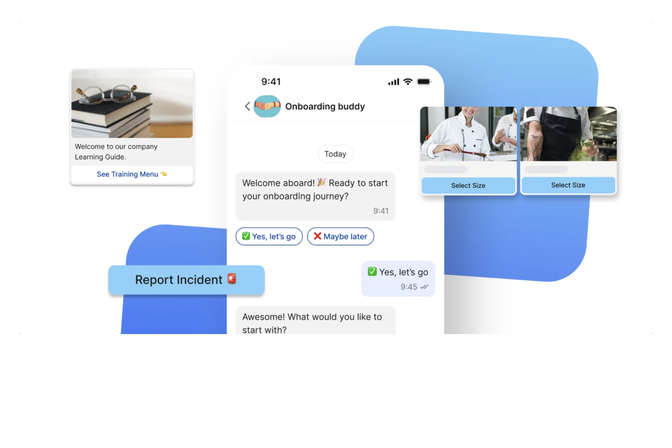
Example of a useful employee engagement app: Flip with its Flip Flows function
Why Frontline Teams Need a Dedicated Employee App, Not a Generic Tool
There is the persistent assumption in the employee technology market that a platform built for desk-based knowledge workers, adapted slightly for mobile use, can adequately serve frontline employees. In practice, this assumption fails consistently, and the consequences appear in engagement scores, retention figures, and day-to-day operational friction.
Frontline workers operate under fundamentally different conditions than office-based colleagues. They often share devices rather than owning dedicated company hardware. They work rotating shift schedules that fragment their interaction with digital tools. They operate in environments where connectivity is inconsistent and attention is limited. And they rarely have time during their working day to navigate a platform that was not designed with their reality in mind.
A dedicated employee app for frontline teams is built around these constraints from the beginning. The home screen surfaces what is relevant right now, today's shift schedule, an unread message from a manager, a pending task, or a news update the entire organization has received. Navigation demands no training. The learning curve is short enough to be irrelevant. And the employee onboarding experience, which are the few weeks during which new hires either embed into the organization or begin quietly detaching, feels intuitive and welcoming rather than another obstacle to getting started.
Built for the Floor, Not the Corner Office
Flip was built with exactly this premise. As an AI-native frontline employee experience platform, Flip's design logic begins with the worker on the floor, not the executive at a desk. Every feature, from checking a payslip to completing a compliance task to sending a message to a peer, is designed to require the fewest possible steps. This is the operational meaning of connecting every employee to everything they need in one touch.
Frontline employees also face specific operational needs that generic platforms handle poorly. Shift schedules, absence requests, time tracking, access to HR documents, and visibility into company processes are not secondary features for these workers. They are the daily infrastructure of their job. An employee engagement app that treats these as marginal add-ons rather than central functions will always feel like it was built for someone else, which is precisely the signal it sends.
There is also the question of reach. A meaningful share of frontline workers do not have corporate email addresses, do not use company-issued laptops, and are not checking an intranet from a browser. A mobile app with its own identity layer and direct notification channel is often the only reliable way to reach these employees at all. Platforms that cannot serve workers without corporate credentials are not frontline platforms, they are office platforms with a mobile view.
Organizations that solve this consistently and well see measurable results within the first six months. Frontline adoption rates increase sharply. Communication reach improves across sites and shifts. Managers report fewer misunderstandings around shift changes and HR processes. And employees, who for years received less information and less recognition than their desk-based colleagues, begin to feel that the organization is genuinely invested in their experience.
Company Culture Starts With a Central Hub, Not a Dozen Different Apps
Ask HR leaders about their biggest internal communication challenge and a familiar answer emerges: information is scattered, tools are fragmented, and no one is confident about where to look for what. Employees receive some updates via email, others through a messaging app, and still others on a noticeboard in the break room. HR processes live in one system. Team communication lives in another. Recognition might not have a dedicated home at all.
The result is a workforce that feels neither informed nor included, These two conditions are fundamentally incompatible with strong company culture.
A central hub changes this architecture. Rather than asking employees to maintain awareness across multiple channels and systems, a central hub gives them one place where everything relevant to their working life is available, organized, and up to date. Communication, HR processes, recognition, feedback, and access to other tools all exist within a single platform. Employees open one app and find everything ready for them.
This matters for company culture in a specific way. Culture is not primarily the product of values statements or leadership speeches, though both play a role. It is the accumulated result of daily interactions: whether an employee felt informed when they clocked in, whether a manager's message arrived before a decision was made, whether a recognition moment happened in front of colleagues or disappeared into a private email thread. When those interactions are consistent, warm, and visible to the whole organization, they compound into a culture that employees can feel. When they are scattered and inconsistent, culture becomes something that exists in the brand book but not in the experience.
A single platform also simplifies the working life of managers considerably. Rather than maintaining separate channels for communication, recognition, and performance management, managers can see everything relevant to their team in one place. They know who has read a critical update, who has completed a task, what the latest survey responses show, and where engagement may be dipping. That visibility is the precondition for meaningful management and it is something that a fragmented tool landscape structurally prevents.
For human resources and internal communications professionals, one platform means one coherent source of data. Instead of assembling a picture of employee experience from multiple disconnected systems, they work from a unified view that supports faster, better-informed decisions. The difference between managing communication and understanding it is often the quality of the data infrastructure underneath.
How to Measure Employee Engagement Inside the App: Actionable Insights That Matter
Employee engagement cannot be managed by assumption. Organizations that believe their workforce is engaged because no one is visibly unhappy are often the most surprised by sudden turnover spikes or culture problems that surface publicly. Measurement is the discipline that closes the gap between what leadership thinks is happening and what employees are actually experiencing, and an employee engagement app is the most powerful measurement infrastructure most organizations have access to.
The starting point is pulse surveys. Short, frequent, and designed for mobile completion, pulse surveys provide a continuous read on employee sentiment rather than a single annual snapshot. Questions can be tailored to current priorities, for example, to the impact of a recent operational change, the experience of a particular team or the effectiveness of a new manager. Because the surveys live inside the app employees already use every day, response rates are substantially higher than anything achieved through email, and the data arrives in real time.
But collecting data is only the foundation. The value of measurement lies in what happens next. Actionable insights are specific: they do not simply tell HR that engagement has dropped three points this quarter. They show which teams are affected, which factors are driving the change, and what responses have worked in comparable situations before. The difference between raw engagement data and actionable insights is the difference between knowing there is a problem and knowing what to do about it.
Advanced Analytics and Real-Time Feedback for Sharper Decision Making
Advanced analytics capabilities give HR leaders and managers a level of visibility that was simply not available through traditional survey approaches. Engagement data can be segmented by team, site, tenure, role, or manager. Keeping track of it makes it possible to identify where in the organization engagement is strong and where it is at risk. Trends become visible over time. Benchmarks provide context. And the moments in the employee lifecycle, the first few weeks, a shift in management, a change in working patterns, where engagement tends to fluctuate can be identified and addressed proactively.
Real-time feedback adds a different dimension. When employees can share concerns, flag issues, or recognize positive experiences as they happen, the organization's ability to respond improves dramatically. A complaint raised through an anonymous feedback channel on a Thursday can be visible to a manager by Thursday afternoon, rather than emerging in an annual survey the following year. That responsiveness sends a powerful signal: that feedback is not just collected but heard, and that the organization is capable of acting on what it learns.
The critical step that many organizations miss is closing the loop. Advanced analytics without action delivers frustration rather than engagement. This means employees who see their feedback disappear into a data system with no visible consequence eventually stop providing it. The most effective engagement apps are built with workflow integration in mind, so that insights surface in the systems managers already use for decision making, and so that the path from data to response is as short as possible.
Frontline managers are the population that benefits most from this kind of direct data access. These are the people who shape their team's daily experience of work more than any other factor, and they are also the people who have historically been furthest from engagement analytics. When real-time feedback and actionable insights reach frontline managers directly, rather than passing first through layers of HR leadership, the organization gains the ability to act locally on locally relevant data. That is where engagement is genuinely created or lost.

Reach your operational teams 80% faster and more reliably
Flip's mobile app combines messaging, chat, HR tools, and your knowledge base in one secure application. No additional tools or licenses required.
How the Right Engagement App Reduces High Turnover
High turnover is one of the most expensive challenges a business faces, and it is directly linked to the quality of employee engagement. A McKinsey study from 2023 estimated that disengagement costs median S&P 500 companies $282 million annually. That is before accounting for the direct cost of replacing people. Recruitment, training, and the productivity loss during transition routinely add up to 40 per cent or more of a departing employee's annual salary. For frontline-heavy organizations, where annual turnover often runs well above the national average, this is not a marginal financial issue. It is a strategic risk.
The connection between engagement and retention is well understood at the level of principle. Employees who feel seen, connected to their company values, and supported in their role stay longer than those who feel overlooked and disconnected. The practical challenge is translating that principle into concrete operational decisions. This is where a well-designed employee engagement app delivers measurable value.
Several features have a particularly direct impact on retention. Boosting engagement through visible recognition is one of the highest-leverage actions available to any HR team: recognition tools ensure that the contribution of individual employees is celebrated openly, and employees who feel consistently valued are far less likely to look for that recognition elsewhere. Anonymous feedback gives employees a constructive channel for frustration before that frustration becomes a decision to leave. Pulse surveys allow HR teams to catch declining engagement at the point where intervention is still possible, rather than at the exit interview.
Retention Starts on Day One
Employee onboarding deserves specific attention here. The first six months of an employee's tenure are the highest-risk period for early attrition. New hires who feel confused, unsupported, or disconnected from the organization during this window are significantly more likely to leave before the end of their first year. An employee engagement app gives new hires immediate access to personalized welcome communications, knowledge bases, HR support, and connections with peers and managers from day one. Organizations that establish this foundation early see a measurable reduction in early attrition.
For organizations with diverse workforces spread across multiple sites, the sense of disconnection that accelerates turnover is particularly acute. Employees at remote locations, or on shift patterns that limit their contact with management, are at the highest risk of feeling invisible. A mobile-first engagement app that reaches them with the same quality of communication, recognition, and HR access as their head-office colleagues creates a sense of parity that matters deeply to long-term commitment.
Leadership visibility also plays a stronger role in retention than many organizations recognize. Employees who hear regularly from senior leaders, may it be through video messages, personalized announcements, or direct engagement within the app, feel a stronger connection to the organization's direction and purpose. An engagement app that makes this kind of leadership communication easy to produce and simple to consume creates a virtuous cycle: more communication generates more connection, more connection generates higher engagement, and higher engagement generates lower turnover.
Michael Heß
Source: Head of Human Resources Development, mhplus Krankenkasse
What to Look for When Choosing the Best Employee Engagement App for Your Organization
Selecting an employee engagement platform is a decision with long-term consequences. A poor platform choice leads to low adoption and wasted budget. Worse, a confusing or unreliable tool can actively damage employee trust and push engagement lower than it was before the investment. A strong choice becomes operational infrastructure: a platform that shapes daily working life positively and grows in value as the organization evolves and scales.
The following questions cut through the marketing noise and identify what actually matters.
Is it genuinely mobile-first? This question eliminates the majority of platforms for frontline-heavy organizations. A mobile app that is a compressed version of a desktop product will never serve frontline employees adequately. Look for a platform where mobile is the primary design context, where the entire experience was built around users who work on their feet, not at a screen.
Does it act as a single platform or add to existing tool sprawl? Many organizations are already managing too many disconnected systems. The right engagement app consolidates rather than multiplies, functioning as a one hub for communication, HR workflows, recognition, and feedback, rather than becoming one more application in an already fragmented landscape.
How deep are the integration capabilities? An employee app lives within a broader technology environment. It needs to connect with payroll systems, workforce management platforms, HR information systems, and other tools that employees and managers rely on. Native integrations that connect directly to source systems deliver better reliability and more useful data than middleware-dependent solutions. Ask vendors to be specific about how their integrations work and which systems they support in depth.
Can it serve different roles without compromise? A shift supervisor and a regional HR director have very different needs from an employee engagement platform. The best apps surface relevant content and functionality based on who is using them — ensuring that every user encounters a version of the platform that feels relevant to their job rather than built for someone else.
What does the customer success team look like? Implementation quality often determines the difference between adoption and abandonment. A customer success team with genuine domain expertise, clear onboarding processes, and ongoing support that extends beyond the initial deployment months is frequently the most important factor in the long-term success of an engagement app. Ask detailed questions about what post-launch support looks like and how proactively the vendor identifies opportunities to improve outcomes.
How does the platform handle security? For any system that holds employee data, HR records, and payroll information, enterprise-grade security is non-negotiable. Data residency policies, compliance with relevant regulations, and transparent access controls should all be verifiable rather than assumed. For organizations operating across multiple geographies, the security posture needs to hold across every jurisdiction.
Does it support the full employee experience lifecycle? The best employee engagement app does not serve only the needs of an employee in their first week, or only the needs of an experienced team member three years in. It supports the full arc — from employee onboarding through to daily work, recognition, development, and ongoing connection with company culture. Platforms that address only one part of this lifecycle are useful point solutions. Platforms that address it fully are employee experience infrastructure.
Will it scale as the organization grows? Platforms that perform well at a thousand employees need to hold up at ten thousand and beyond. Ask vendors about their largest deployments, their track record with organizations of comparable size and complexity, and how they maintain performance and reliability at scale.
Building a Stronger Employee Experience With Flip
Flip is the AI-native frontline employee experience platform purpose-built for organizations whose frontline workforce is not a segment to accommodate, it is the core of the business. Designed from the ground up around the needs of workers who do not sit at desks, Flip brings communication, HR processes, recognition, feedback, and AI-powered assistance together in a single mobile app that employees across different roles and locations use every day.
Flip Comms provides the internal communication foundation: structured news feeds, channels, direct messaging, and push notifications that reach every employee immediately. Flip Flows enables employees and managers to execute HR and operational workflows directly inside the app, such as shift confirmations, absence requests, onboarding steps, and more, without switching to a separate system. Flip Identity gives every frontline worker a secure digital identity that removes the friction of multiple credentials, delivering one-touch access to connected systems from a single platform. And Flip's AI layer, including Ask AI and Flip Agents, moves beyond answering questions to completing tasks, surfacing relevant information proactively, and automating the repetitive processes that consume time frontline employees could spend on work that matters.
Customers including REWE, Bosch, and Porsche have deployed Flip at scale, with documented improvements in frontline communication reach, employee onboarding speed, and engagement survey participation. A customer success team with deep domain knowledge supports every deployment, ensuring that organizations move from implementation to measurable impact as efficiently as possible.
What we can see today is that the market is moving toward a genuine system of action, one woven into the daily operational reality of frontline work. For HR leaders, internal communications professionals, and operations teams ready to make that move, Flip is the platform built for exactly this moment.
Source: McKinsey, Some employees are destroying value. Others are building it. Do you know the difference?
FAQ
A strong employee engagement app needs mobile-first design that delivers easy access to shift schedules, news, and HR information without friction. Push notifications keep employees informed in real time. Internal communication tools — including news feeds, channels, and direct messaging — connect employees to their organization and to each other. Recognition tools and public shout-outs make appreciation visible. Pulse surveys and anonymous feedback give employees a voice. Advanced analytics provide managers and HR with actionable insights from the data. Multilingual support ensures the platform works equitably for global and diverse workforces. And deep integrations with HR, payroll, and operational systems mean the app functions as a true central hub rather than an additional tool. In 2026, AI-powered features that automate tasks and surface relevant information proactively are increasingly what separates the best employee engagement apps from the rest.
Frontline employees are typically the most underserved group in any organization's technology stack — and the most affected by disengagement. An employee app designed specifically for frontline teams gives these workers reliable access to the information and processes they need most: shift schedules, HR services, company news, and direct communication with their managers and peers. It removes the requirement for corporate email addresses or desktop access, reaching employees through the mobile device they already have. Recognition tools ensure that the contributions of frontline workers are visible and valued. Anonymous feedback channels give them a safe way to raise concerns. And consistent, high-quality communication makes them feel part of the organization rather than peripheral to it. These factors directly influence retention: frontline employees who feel connected and recognized are substantially more likely to stay.
Measuring employee engagement inside an app works best as a continuous process rather than a periodic event. Pulse surveys and polls provide regular, structured data on employee sentiment. Anonymous feedback captures honest views that might not surface through other channels. Advanced analytics segment engagement data by team, location, role, and tenure — giving HR teams and managers a precise picture of where engagement is strong and where it is at risk. Real-time feedback mechanisms allow employees to share concerns as they arise, reducing the lag between experience and organizational awareness. Behavioral data — including app adoption rates, communication reach, and feature usage — adds a further layer of insight. Together, these inputs generate the actionable insights that enable meaningful, well-timed responses rather than reactive damage control.
High turnover and low engagement are deeply connected. The right employee engagement app reduces turnover by addressing the conditions that drive disengagement before they become resignations. Recognition tools ensure employees feel valued for their contributions — a consistently under-delivered experience in frontline environments. Pulse surveys and anonymous feedback give HR teams early visibility into declining engagement, creating space to respond before the relationship breaks down. Strong employee onboarding delivered through the app gives new hires the connection and clarity they need to commit to the organization long-term. And regular, visible leadership communication reinforces the sense of purpose and belonging that keeps employees invested in their role. Organizations that deploy employee engagement apps effectively typically see measurable retention improvements within the first six months, particularly among frontline and shift-based workers where turnover historically runs highest.
For smaller organizations, the priority should be a platform that delivers core functionality — communication, recognition, feedback, and HR access — without requiring extensive IT resource to implement or maintain. The best employee engagement app for a small business is one that can be deployed quickly, adopted easily without formal training, and scaled if the organization grows. Mobile-first design matters regardless of company size, particularly if the workforce includes any frontline or deskless employees. Multilingual support becomes important sooner than many small businesses expect. And the quality of the customer success team is arguably even more important at smaller scale, where internal implementation resources are limited. Look for platforms with transparent pricing, fast onboarding timelines, and a clear record of serving organizations at a similar stage of growth to your own.
Reach your operational teams 80% faster and more reliably
Flip's mobile app combines messaging, chat, HR tools, and your knowledge base in one secure application. No additional tools or licenses required.

Dr. Franzi Finkenstein
Dr. Franzi Finkenstein is part of the Content & Search team at Flip, writing about digital communication, employee engagement and AI–human connections. Drawing on a humanities PhD and extensive editorial experience, she focuses on how digital technology is reshaping the future of work and explores how employee health and wellbeing in modern workplaces can be improved.
Don’t forget to share this content

More on the topic of Employee Engagement

Employee app: 10 best tools for internal communication 2025
AI-First Employee Experience Platform: 2026 Trends & One-Touch

Digital Workplace: how AI is changing everything