






How to Reach Frontline Workers: Trust Can't Be Broadcast
Published:
"How do you get the works council on board early?" That was the first question after the masterclass that Giacomo Kenner, Co-Founder of Flip AI, gave at INKOMETA Days in Berlin on November 18, 2026. The session was titled "Trust can't be broadcast" (German original: "Vertrauen lässt sich nicht broadcasten").
Kenner opened with one number: 83% of frontline workers don't have a corporate email address. The figure comes from Flip AI's 2026 report Why AI is failing frontline workers. Think about your last company-wide update. It went out. For most of your workforce, it landed nowhere.
 Dr. Nirmalarajah Asokan
Key Takeaways
How to reach frontline workers starts with access: 83% of frontline workers have no corporate email (Flip AI report, 2026), so email-based channels miss most of them.
Only 23% of US frontline workers believe senior leadership understands what is really happening in their workplace (ZipRecruiter Breakroom Workplace Index, 2025).
49% of frontline workers say the best ideas for operational improvements come from their own ranks, compared with 23% who credit leadership (SafetyCulture, 2023).
Better success metrics than news reach are weekly logged-in employees, the share of posts from local senders, and the days from a local idea to a solution.
Frontline has arrived on the agenda at INKOMETA Days 2026, and leaders are the decisive channel in change, says Giacomo Kenner. Two practical checks when comparing vendors: access without a company email and getting from answer to action.
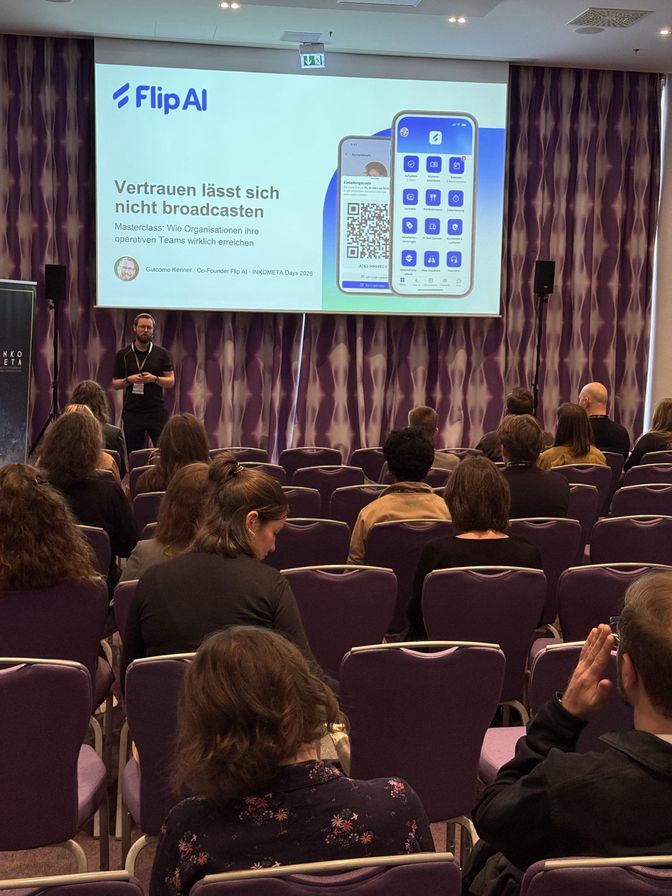
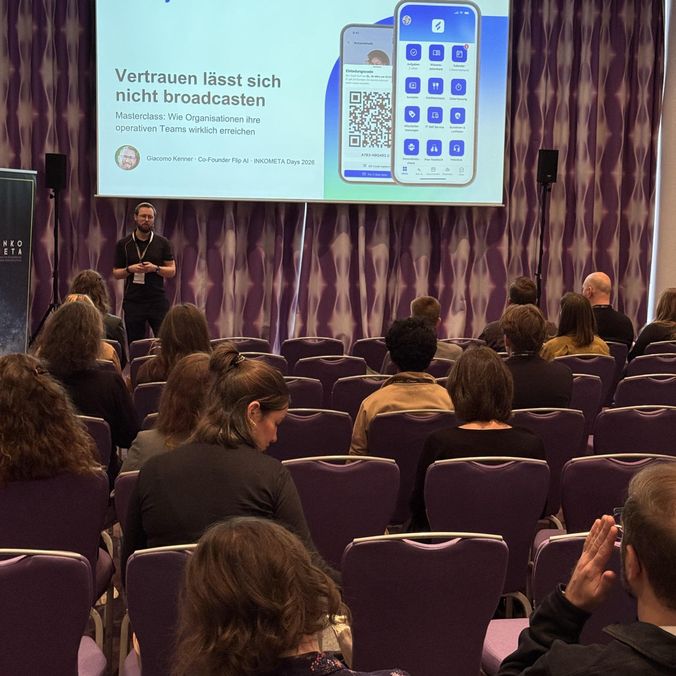
Giacomo Kenner, Co-Founder of Flip AI, presents the masterclass "Trust can't be broadcast" at INKOMETA Days 2026 in Berlin.
The question shows what is changing. Frontline workers, whom internal communications long barely reached, are getting noticeably more attention, and more communication teams plan with local leaders and the daily work of the teams from the start.
To reach frontline workers, fix access before you produce more content. Give every employee a personal login that works without a corporate email or a PC. Then open channels where frontline staff can post and get visible answers, and let local managers solve their own problems with tools they build themselves. Measure logins, local posts and time to resolution. Below are Kenner's three theses, the data behind them, his answers to the questions from the room and what the event showed about frontline communication in 2026.
See how Flip AI reaches every employeeWhy don't your messages reach frontline workers?
Most internal communication teams measure output: articles published, campaigns launched, newsletter opens. Those numbers describe the sender. They say little about whether a picker on the night shift ever saw the message.
Kenner opens his talk with three numbers. The first is the 83% without a corporate email, from Flip AI's 2026 report, based on more than 1,000 deployments and a survey of 1,500+ frontline employees and managers in the UK, the US and Germany. The second comes from Germany: in a YouGov survey of 505 employees without a computer workstation, commissioned by HIRSCHTEC and Flip AI in 2026, 60% said their company has no company-owned mobile employee app. The third is about trust. According to the ZipRecruiter Breakroom Workplace Index, only 23% of US frontline workers believe senior leadership understands what is really happening in their workplace.
The trend points the wrong way. Dayforce research reported by HR Dive found that 42% of frontline workers felt their company's leaders understood their problems, down from 62% in 2024. Kenner draws one conclusion from these numbers. People who don't feel understood won't believe the next message from the top. And before any message can land, people need a way in.
See what a frontline employee app can doMeet Flip AI: an employee app built to reach frontline teams.
Is access the real bottleneck?
Picture a factory break room. Thirty minutes of break, one shared information kiosk, a line of people waiting to check a payslip or request vacation. That was reality at Bosch USA for decades, because most people at its production sites have no PC, no company phone and no email. The result, as the Bosch customer story describes it: long queues, breaks spent waiting, and important updates that landed late or not at all.
That queue is the first thesis of the talk in a single image. Invest in access, not in content. Most internal communication budgets flow into content and campaigns, while many frontline employees are not even logged in. Kenner sees two patterns.
The first is the missing digital identity. A whole shift shares one terminal. Without a personal login there is no read confirmation for safety briefings, and every password reset becomes an IT ticket.
The second is a login that exists but is too complicated. More than ten setup steps. No corporate email, so no magic link. Unreliable SMS codes and separate authenticator apps. Many people give up before they read their first message. The line on Kenner's slide sums it up (our translation from German): "If you're not logged in, you miss everything, and if you miss everything, you don't belong."
Employees know what they need. In the HIRSCHTEC and Flip AI study, 85% named a simple, secure login with direct access to all tools as their top requirement. Flip AI's report adds the payoff: when employers rebuild access around identifiers workers already know, weekly active usage typically jumps from 5 to 10% to between 60 and 100%.
What does good access look like? The store manager sees in the app who is still missing and opens that person's QR code, and the employee scans it with their own phone. No PC, no corporate email, no password letter. At EDEKA, where login works without email or PC, the app reaches a 97% daily usage rate. At Ben & Jerry's ANZ, 70% of employees were active within three days of launch, without formal training. Kenner's self-test: how many of your operational employees were logged in last week?
See Frontline Identity in actionFrontline Identity by Flip AI: employee login without email.
Why does the frontline stay silent?
In most companies, communication runs top down: head office, regional management, store management, then the floor. The way back is often missing. Kenner names three reasons. No permission, because only what the editors approve gets published. No channel where employees may post on their own. And no answer, so people who never get a reply stop reporting.
That wastes the best knowledge a company has. SafetyCulture's 2023 report Feedback from the Field: Room for Improvement, based on a YouGov survey of 2,057 frontline workers in Australia, the UK and the US, found that 49% believe the best ideas for operational improvements come from frontline workers themselves, while only 23% credit leadership. A third of respondents (30%) said their leaders don't encourage improvements.
That is why the second thesis says: make the floor the sender. Kenner's example comes from a German drugstore chain (anonymized). An employee notices that a soap delivery has arrived damaged again. She posts a photo in the company channel and asks whether other stores see the same thing. Stores from across Germany reply that they do. Head office traces the damage to a supplier error, and the packaging changes nationwide. Before, each store had solved the same problem alone, again and again.
At EUROPART, an ideas channel produces more than 150 improvement suggestions a year, and 98% get implemented. The condition, for skeptics who fear the floor will only complain: head office has to answer visibly.
Martina Merz, former CEO of thyssenkrupp, made the same point on Flip AI's podcast Wo Wandel wirkt: "Communication today: you cannot make an announcement and call it done. You have to check whether your communication was actually understood, whether employee A and employee B are discussing the same thing." (Wo Wandel wirkt with Martina Merz, translated from German.) A channel where the floor can answer back is how you run that check.
See how two-way frontline comms workWhat happens to ideas from local teams?
The third thesis goes furthest. Let teams on site solve their own problems. Shift leads and store managers know where the friction is and have ideas: a digital shift handover, a cold chain checklist, hazard reports with photos. They are rarely allowed to build the fix.
Instead, ideas wait in the IT backlog for months, because custom development costs six-figure budgets. Spreadsheets and group chats fill the gap as shadow IT, or a standalone app gets bought that lives outside daily work. The team learns that nothing moves. Dayforce research from 2026 (n=5,693, six countries) puts a number on it: 77% of frontline managers say their systems don't give clear guidance when operational issues arise.
Sonderpreis Baumarkt, a German discount DIY chain with 364 stores, shows the alternative. Its internal communications team built a store check and safe count app with an AI App Builder, without code and without an IT project. As of November 2026, it has logged 1,210 daily checks, 700 safe counts and 101 key handovers in 25 test stores. The advice from Bea Arbeiter, who works in internal communications at the company, matches the thesis: start with the workflows the stores need and that make their lives easier, because that is how acceptance grows.
Susan-Stefanie Breitkopf, former CTO of ZEISS, described the principle behind it on Wo Wandel wirkt: "What I have found helpful in major change processes: changing things together with the people who have been doing them that way for 20 years. They usually know better than anyone what actually works." (Wo Wandel wirkt with Susan-Stefanie Breitkopf, translated from German.)
See what teams can build with FusionFusion by Flip AI: build operational apps for frontline teams.
How toom brings all three theses together
toom, a German DIY retailer with around 18,000 employees in 330 stores, is Kenner's example for all three theses. Before its app, toom relied on notices, emails to store managers and printouts in break rooms. Today the toomunity app has onboarded 12,537 users. Access comes through payslips and shift plans, ideas from the floor are routed to one of six departments, and an AI assistant called Bert answers questions around the clock. Daria Ezazi, Head of Corporate Communications, describes the effect: "The knowledge of toom is now in your pocket: employees can check from anywhere which shift is coming up, book holiday, access product information or ask colleagues about a problem."
It also shows the urgency: 95% of toom's shop floor employees had never used AI. Knowledge workers are getting assistants and agents right now. If the frontline comes last again, the gap widens.
See Ask AI on the shop floorWhat did INKOMETA Days 2026 show about frontline communication?
Frontline moved closer to the center of internal communications this year. At INKOMETA Days in Berlin, the topic and the word "frontline" were more present than before, in the programme and in the conversations between sessions. Kenner's recap says it directly (translated from German): "The frontline has arrived on the agenda, on stage as much as in the conversations between sessions." The masterclass took place on the second day.
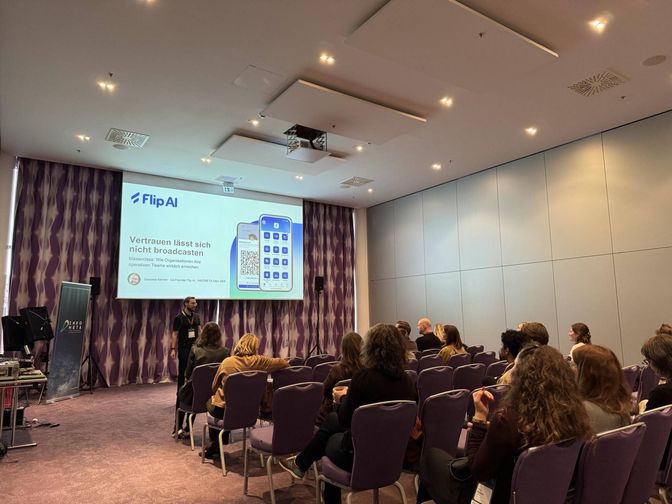
The audience at the Flip AI masterclass at INKOMETA Days 2026 in Berlin.
Kenner sees a second shift behind it. More and more communication teams look beyond communications itself and plan with local leaders and the daily work of the teams from the start. His second takeaway follows from that (translated from German): "Leaders are the decisive channel, especially during change. Many talks showed how to enable them in a targeted way."
Kenner named three talks that stayed with him. Hülpert Unternehmensgruppe showed impressive usage numbers, which he calls rare for a pure communications platform. He credits a well-thought-out rollout in which individual sites and leaders took ownership, plus a lot of commitment and creativity in the campaigns, and he gives a big compliment to Lea Cymontkowski. At BVG, Maja Weihgold showed how internal communications works when a company is in the public eye and employees speak to the press and the outside world themselves. Her line, translated from German: "Our job is not to make everyone speak with one voice." At METRO, Elisabeth Hesse links strategy and sales goals through "The Big Fresh" and so engages and motivates teams across countries.
See how Flip AI supports local leadersHow do you bring the works council on board early?
That was the first question after the masterclass. Kenner's answer (translated from German): involve it in the planning, not only at the approval stage. "The most successful rollouts I know saw the works council as a co-designer from the start." In those rollouts it gets its own channel, helps define the rules, and it is clearly settled which data is collected and which is not. Early transparency on data protection and voluntariness saves months of coordination later. In his words, the works council often becomes the app's strongest advocate that way.
See a login that works without email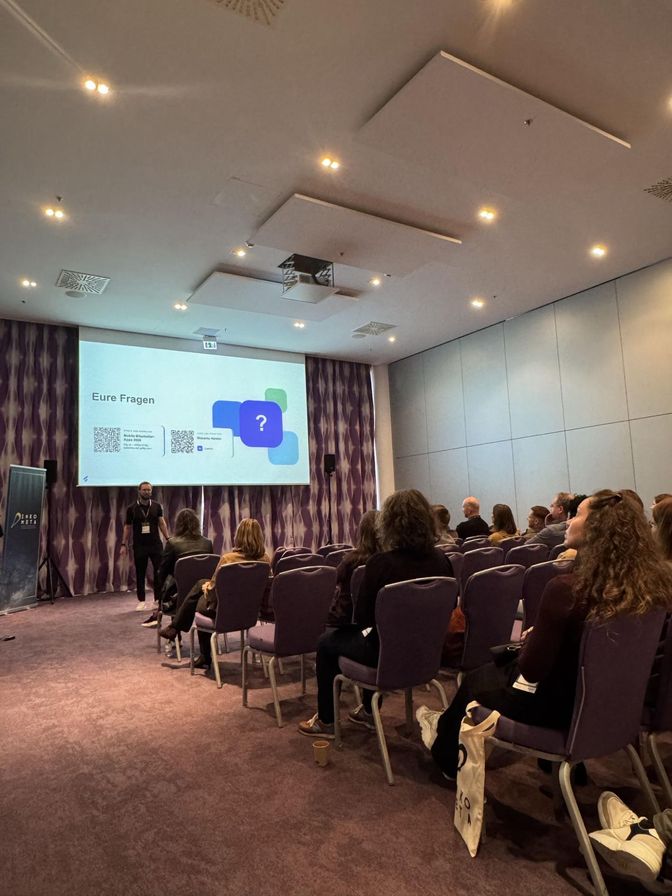
The Q&A at the end of the masterclass. The first question was about the works council.
What happens when all employees can post?
Less work than most teams fear, says Kenner. Moderation rarely becomes a problem when the rules are clear: who may post where, which channels are open and which are reserved for communications. The real effort lies elsewhere. Posts from the teams have to become visible and get appreciation, otherwise they dry up quickly, and that is exactly where trust is built. In his words (translated from German): "A photo of the shift team often says more than the third all-staff email from head office." It matches the EUROPART condition above: the floor keeps talking when head office answers visibly.
See how every employee can have a voiceHow should you compare vendors for frontline communication?
Carsten Rossi of the agency Kammann Rossi ran a masterclass at INKOMETA Days on how AI can open the way to the frontline, and he compared vendors, Flip AI among them, on two criteria. Both work as checklist items for your own evaluation. First, access without a company email: can people get in with a QR code, an invite code or a passkey, also on shared devices? Second, from answer to action: does the AI only answer a question, or can it also take the next step, for example filing an absence request through a connection to systems like Workday, SAP or Jira? Flip AI's Frontline Identity speaks to the first criterion, since login works through QR code activation and other methods that don't depend on a corporate email. Ask every vendor, Flip AI included, to show both live.
Flows by Flip AI: from an answer to the next action.
Where Flip AI fits
Read the three theses as layers. Access needs an identity layer that works without corporate email. Dialog needs channels where every employee can post and get an answer. Enablement needs tools local teams can build with.
This is the problem Flip AI was built for. Flip AI is named a Leader in the 2026 Gartner Magic Quadrant for Frontline Worker Communication Applications.
Gartner, Magic Quadrant for Frontline Worker Communication Applications. GARTNER is a registered trademark and service mark of Gartner, Inc. and/or its affiliates in the U.S. and internationally, and MAGIC QUADRANT is a registered trademark of Gartner, Inc. and/or its affiliates and are used herein with permission. All rights reserved. Gartner does not endorse any vendor, product or service depicted in its research publications and does not advise technology users to select only those vendors with the highest ratings or other designation. Gartner research publications consist of the opinions of Gartner's Research & Advisory organization and should not be construed as statements of fact. Gartner disclaims all warranties, expressed or implied, with respect to this research, including any warranties of merchantability or fitness for a particular purpose.
Frontline Identity handles login through QR code activation and other methods that don't depend on a corporate email. The employee app gives every location a channel to speak up. Fusion, the AI App Builder, and Flows let teams digitize their own processes, and Ask AI puts company knowledge in every pocket. None of it replaces good internal communication. It makes sure that good communication reaches people.
What should you measure instead of reach?
Kenner closes with the slide he invites the audience to photograph. Each thesis gets one metric that replaces a familiar one:
| Thesis | What most teams report today | What to measure instead |
|---|---|---|
| Access | Overall reach of news | Logged-in employees per week |
| Dialog | Number of news posts from head office | Share of interactions and posts from local employees |
| Enablement | Survey participation rate | Days from a local idea to a solution |
His final sentence (our translation) is the best summary of how to reach frontline workers: "Trust can't be broadcast. It grows when everyone has access, everyone is heard, and teams can solve problems on site quickly themselves."
FAQ
Give them a personal login that doesn't depend on email, such as QR code activation by the store manager, single sign-on or passkeys. 85% of frontline employees in a German YouGov study named a simple, secure login as their top requirement for an employee app.
A mobile employee app that combines news with tools people use every week, such as payslips and shift plans. Kiosks, printed notices and manager cascades reach only part of the workforce and offer no way to answer.
First because they can't access them, then because they don't trust them. 83% have no corporate email (Flip AI, 2026), and only 23% of US frontline workers believe senior leaders understand their reality (ZipRecruiter, 2025).
Give them permission, a channel and an answer. Employees need a place to post without prior approval, and head office has to respond visibly.
In the model Kenner describes, using a personal phone is voluntary, and QR code login works without private data such as a phone number.
Track logged-in employees per week instead of news reach, the share of posts from local employees instead of the number of head office posts, and the days from a local idea to a solution instead of survey participation.
Check two things first: whether employees can get access without a company email, for example with a QR code, an invite code or a passkey, also on shared devices, and whether the AI gets people from an answer to an action, for example through a connection to systems like Workday, SAP or Jira. Carsten Rossi of Kammann Rossi compared vendors on exactly these two criteria in his masterclass at INKOMETA Days Berlin in November 2026.
Involve it in the planning, not only at the approval stage. Giacomo Kenner says the most successful rollouts he knows treated the works council as a co-designer: it gets its own channel, helps define the rules, and it is clearly settled which data is collected and which is not.
Less than most teams fear, as long as the rules are clear: who may post where, which channels are open and which are reserved for communications. The real effort is making posts from the teams visible and appreciated, otherwise they dry up quickly.

Dr. Nirmalarajah Asokan
Dr. Nirmalarajah Asokan is Senior Content Marketing Manager at Flip AI and writes about topics such as HR digitalization, employee apps, internal communications, and AI transformation. With an academic background and many years of experience in content marketing and SEO, he specializes in practical, data-driven content on employee experience, change management, and digital collaboration for modern organizations.
Don’t forget to share this content

More on the topic of Employee Engagement

Employee app: 10 best tools for internal communication 2025
Microsoft Teams vs frontline employee apps (2026 guide)

Employee app vs intranet: which suits frontline teams?