






What Gartner's First Magic Quadrant for Frontline Worker Communication Applications Means for Frontline Work
Published:
In November 2026, Gartner® published its inaugural Magic Quadrant™ for Frontline Worker Communication Applications, the first analyst evaluation dedicated to this market. Flip AI is named a Leader. For me, the bigger story is this: frontline tech is finally moving from broadcasting messages to actually getting work done.
 Tom Gibby
Key Takeaways
Flip AI is named a Leader in the 2026 Gartner® Magic Quadrant™ for Frontline Worker Communication Applications, the first Magic Quadrant Gartner has published for this category. It covers platforms serving frontline workers in manufacturing, logistics, retail, healthcare, and hospitality.
A frontline worker communication application is software for people who work without a desk, a laptop, or a corporate email address. It has to work from a phone, in a warehouse, on a shop floor.
The category has moved from reach to execution. Workers need answers, system access, and a way to get things done. A smaller copy of the corporate intranet won't do it.
AI is shifting frontline platforms from "find the information" to "complete the task." That's a big difference.
When you choose a platform, ask whether it works without corporate email, whether it's genuinely mobile-first, whether it connects to existing systems, and whether it can take action instead of only informing.
The world's largest workforce got the smallest slice of the digital workplace budget
Enterprise technology was built around a desk. A laptop. A corporate email address. A working environment that looks pretty much the same every day.
That assumption is baked into every intranet, every enterprise messaging platform and every identity system rolled out over the last two decades. The people buying the software were IT directors sitting at keyboards, and everyone assumed the people using it would look the same.
The people who keep our hospitals running, manufacture our products, deliver our packages, stock our shelves, and serve our customers were an afterthought.
Picture a warehouse worker halfway through a shift. They need a safety procedure, fast. The answer is probably sitting somewhere on the company intranet, but spending ten minutes digging through a desktop system mid-shift just isn't realistic. So they ask a colleague. Or they guess. Or they skip it.
Or a nurse who needs a critical policy update during handover. No laptop. No corporate email. No time.
Or a retail store manager onboarding a new hire from their phone, juggling system access, training materials, and a uniform order all at once.
None of these people were who the software was built for. The digital workplace was designed for someone sitting at a computer, with time to search and read.
That's starting to change.
Why a frontline Magic Quadrant matters now
When Gartner publishes a Magic Quadrant for a category, it sends a signal: the market has grown up enough that buyers need a framework.
That's exactly where frontline worker communication applications are today. For years, buying decisions in this space were pretty informal. IT bolted on a consumer messaging app. HR licensed an intranet add-on and crossed their fingers that it would reach the warehouse floor. The vendors were fragmented, and nobody was clear on the buying criteria.
That's changed. Today the buyers include IT, HR, operations, and internal communications. They're evaluating at enterprise scale with real procurement criteria: security, governance, integration with existing systems, the ability to work without corporate email, and mobile-first design that's the real thing.
From where I sit, a dedicated Magic Quadrant for Frontline Worker Communication Applications reflects that maturity. It tells buyers this is a real software category, with meaningful differences between platforms, and it deserves a proper evaluation. It tells vendors something too. You're being measured.
What a frontline worker communication application is (and what it's turning into)
Let's start with the basics. A frontline worker communication application is software built for employees who don't sit at a desk. It gives them a way to get information, connect with their team, and reach what they need from a mobile device, with no corporate email address or laptop required.
That's the baseline. The category is moving fast, though.
The first wave of frontline employee apps solved a reach problem. Organizations could finally get information to workers who had been cut off from the digital workplace. That was valuable. It just wasn't enough.
The frontline doesn't need a shrunk-down version of the digital workplace. Workers need answers, access, and a way to get things done. The platforms winning in this category have moved from broadcasting to execution.
Here's what that looks like in real life. Someone on a manufacturing floor spots damaged equipment. They should be able to report it from their phone, trigger a maintenance request, and get confirmation in one flow, without hunting down a supervisor or filling out a paper form. A logistics company rolls out a new delivery procedure, and workers want to ask a question in plain language and get the right answer straight away instead of scrolling through a 12-page PDF. A retailer brings on a seasonal cohort, and every new hire needs system access, compliance training, and a first-day checklist, coordinated automatically. A healthcare network sends an urgent operational update and needs to know it was actually read.
Communications got frontline workers connected. The next chapter is making them capable.
See how the Flip AI employee app worksAI workflows in Flip AI: easily modernize operational processes like capturing recognition and rewards
How AI changes what frontline work looks like
The platforms doing the most interesting work right now didn't bolt AI on at the end as a feature. AI is the architecture.
Take a knowledge assistant that understands a question asked in plain language, searches across company systems, and comes back with the right answer, in context. You get an answer, where you used to get a search bar. That's what Ask AI makes possible.
Then there are intelligent workflows that react to events instead of waiting for someone to remember to kick them off. Damaged equipment triggers the maintenance ticket. A finished onboarding module opens up the next training step. A safety check due date sends a reminder before the shift starts.
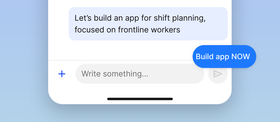
Add the ability to build custom apps for specific operational needs, without a team of developers and a six-month roadmap. If you've ever wanted to digitize a checklist, a reporting form, or an inspection procedure and been told it would take a year and a budget you don't have, you'll get why this matters.
And then AI agents that take action instead of answering questions. A worker asks why a delivery is delayed. The agent checks the system, finds the issue, files the update, and replies with the resolution. Search never did that for anyone. That's work getting done.
So the future of frontline AI is about helping employees take the right action. Finding the right answer is only where it starts.
See Ask AI in actionAsk AI in Flip AI: answers and actions for frontline teams.
How to choose a frontline worker communication app
If you're evaluating frontline communications platforms for your organization, these are the questions that cut through the noise.
Can it work without a corporate email address? Most frontline workers don't have one, so any platform that needs one for login shuts out the people it's supposed to serve. Look for passwordless login options: QR codes, invite links, passkeys.
Is it genuinely mobile-first? Built for mobile and adapted for mobile are two very different things. People will use this on a phone, in a warehouse, on a shop floor, and it has to hold up there.
Can it give workers answers in context? Pushing notifications isn't enough anymore. Workers need to ask questions and get useful answers from company knowledge without jumping into a separate system.
Does it connect to the systems your organization already runs? A communications tool sitting on its own island is a comms tool. Connect it to your HR system, your ERP, and your ticketing system, and it becomes infrastructure. For adoption, that difference matters enormously.
Does it help workers take action, or only inform them? This is the category shift. The deskless worker software that wins the next decade will be the platforms that do work.
Does it meet enterprise security and governance requirements? Frontline workers are inside your infrastructure. That means audit logs, role-based access control, single sign-on, and the ability to deprovision access when someone leaves. Table stakes.
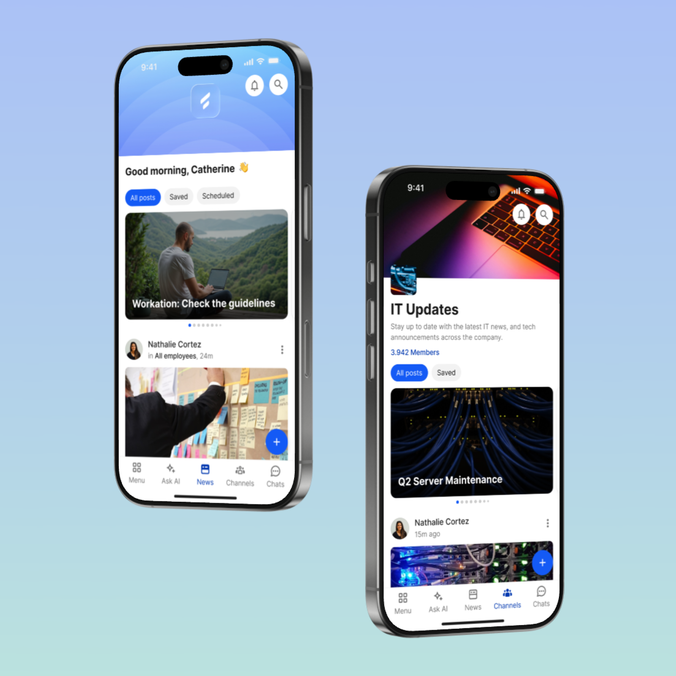
Frontline Identity by Flip AI: employee login without email.
Where Flip AI fits
Flip AI was founded in Stuttgart in 2018. Today we're trusted by more than 1,000 enterprise brands, with more than two million users across manufacturing, logistics, retail, healthcare, and hospitality. We have offices in Germany, the UK, and the US.
We think of Flip AI as the operating system for frontline work. Communications sits at the core. Frontline Identity handles secure, passwordless access without corporate email. Fusion lets operations teams build operational apps in minutes rather than months. Flows automates the processes that currently live in someone's head. And Ask AI connects workers to answers, and to agents that act.
Take a closer look at FusionFusion by Flip AI: build operational apps for frontline teams.
Why the recognition matters to me
We're proud to be named a Leader in the 2026 Gartner® Magic Quadrant™ for Frontline Worker Communication Applications. Read the full announcement: Flip AI named a Leader in the 2026 Gartner Magic Quadrant
Gartner, Magic Quadrant for Frontline Worker Communication Applications, Alexandra Earl, Catherine Donnelly, Mike Gotta, 16 November 2026. GARTNER is a registered trademark and service mark of Gartner, Inc. and/or its affiliates in the U.S. and internationally, and MAGIC QUADRANT is a registered trademark of Gartner, Inc. and/or its affiliates and are used herein with permission. All rights reserved. Gartner does not endorse any vendor, product or service depicted in its research publications and does not advise technology users to select only those vendors with the highest ratings or other designation. Gartner research publications consist of the opinions of Gartner's Research & Advisory organization and should not be construed as statements of fact. Gartner disclaims all warranties, expressed or implied, with respect to this research, including any warranties of merchantability or fitness for a particular purpose.
But I'll be honest. The recognition matters less to me than what the category now represents. Gartner formalizing this market means every CHRO, every IT director, and every COO evaluating frontline technology now has a framework for doing it properly. That's good news for the 2.7 billion frontline workers worldwide who depend on the platforms this industry builds.
This is about more than one company.
The frontline's digital future is only just beginning
For too long, enterprise technology assumed the people who mattered most were the ones sitting at a desk.
The warehouse worker. The nurse. The retail associate. The logistics driver. They've kept the global economy running through every disruption of the last decade, and they've done it with worse tools, less support, and far less investment than their office-based counterparts.
A dedicated Gartner Magic Quadrant for Frontline Worker Communication Applications is a sign that the industry is finally catching up with reality.
There are 2.7 billion frontline workers worldwide. The organizations that win the next decade will be the ones that give them the technology they actually need, instead of a cut-down version of something built for someone else.
The frontline workforce has always been essential to the global economy. It's about time enterprise technology treated it that way.
FAQ
The Gartner® Magic Quadrant™ for Frontline Worker Communication Applications is the first analyst evaluation Gartner has published for this market. Published in November 2026, it covers platforms designed to serve frontline workers in industries including manufacturing, logistics, retail, healthcare, and hospitality. It gives enterprise buyers a consistent framework for evaluating vendors in a category that has historically been an informal purchasing decision.
A frontline worker communication application is software built for employees who work without a desk: on the shop floor, in a warehouse, on a delivery route, in a hospital ward, or in a retail store. It gives those workers access to company communications, knowledge, and operational tools from a mobile device, without requiring a corporate email address or a laptop. The category has evolved from messaging and news delivery toward platforms that connect workers to systems, enable workflows, and use AI to help workers take action instead of hunting for information.
The key questions: Can it work without corporate email? Is it genuinely mobile-first? Can it give workers answers in context, drawn from your company's own knowledge? Does it connect to your existing systems? Does it help workers complete tasks, beyond receiving updates? Does it meet enterprise security and governance requirements? A platform that checks all six is operating infrastructure for frontline work. See our guide to deskless worker software for a full breakdown.
From our perspective in the market, the category earned it. Buying decisions now involve IT, HR, operations, and communications leaders evaluating at enterprise scale. Vendors have matured, product categories have sharpened, and the stakes for choosing the wrong platform are significant. A Magic Quadrant formalizes the evaluation process and signals that this space deserves analytical rigor.
An intranet was designed for someone with a laptop, time, and a corporate email address. A frontline employee communication app is built on the opposite assumptions: mobile-first, accessible without corporate credentials, optimized for quick consumption and action. Beyond that, the best frontline platforms today connect workers to systems, automate workflows, and use AI to deliver answers directly, so workers don't have to go looking for them.
Yes. Flip AI is named a Leader in the 2026 Gartner® Magic Quadrant™ for Frontline Worker Communication Applications, Gartner's inaugural evaluation of this market, published November 2026. Read the press release for full details.
Disclaimer
Gartner, Magic Quadrant for Frontline Worker Communication Applications, Alexandra Earl, Catherine Donnelly, Mike Gotta, 16 November 2026. GARTNER is a registered trademark and service mark of Gartner, Inc. and/or its affiliates in the U.S. and internationally, and MAGIC QUADRANT is a registered trademark of Gartner, Inc. and/or its affiliates and are used herein with permission. All rights reserved. Gartner does not endorse any vendor, product or service depicted in its research publications and does not advise technology users to select only those vendors with the highest ratings or other designation. Gartner research publications consist of the opinions of Gartner's Research & Advisory organization and should not be construed as statements of fact. Gartner disclaims all warranties, expressed or implied, with respect to this research, including any warranties of merchantability or fitness for a particular purpose.

Tom Gibby
Tom Gibby is Head of Product Marketing at Flip AI, where he leads product positioning, launches and go-to-market for the company's AI-powered frontline platform. He joined Flip when it acquired The Bot Platform, which he co-founded and ran as CMO. Before that, he worked in advertising as a Strategy Director at world-renowned creative agencies, including Wieden+Kennedy and Droga5.
Don’t forget to share this content

More on the topic of

Best AI app builders for frontline teams (2026)

Communication Gap in Remote and Frontline Teams: Best Solution

AI-First Employee Experience Platform: 2026 Trends & One-Touch