






The frontline worker app: why the future of work starts on the shop floor
In Victorian Britain, the Post Office maintained an entire department dedicated to undeliverable mail: the Dead Letter Office. Letters written with care, sent with urgency, and never opened. They were not lost to indifference, but to the failure of the system carrying them.
The same failure plays out in organizations every day. Companies invest heavily in strategy and leadership communication, then allow that investment to quietly expire before it reaches the shop floor, simply because the people working there do not have a company email address. This article explores what that distance costs in lost productivity, disengagement, and missed operational performance, and why a frontline worker app is the most direct way to close it: by reaching every employee in real time, on a mobile device, without a company email address or a laptop in sight.
 Dr. Franzi Finkenstein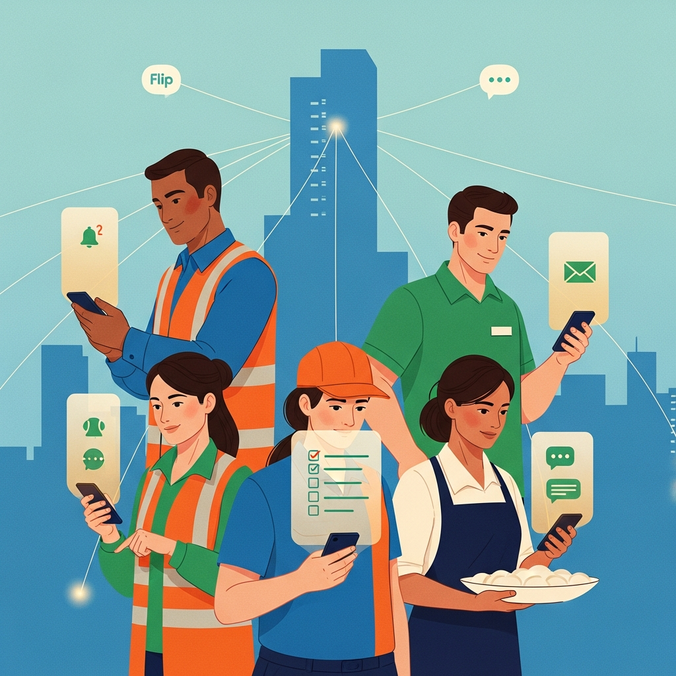
Key Takeaways
Over 2.7 billion workers globally are deskless , yet most enterprise digital tools were built exclusively for people sitting behind a screen, leaving the majority of the world's workforce without reliable access to company communication.
A purpose-built frontline worker app closes the gap between headquarters and the shop floor by delivering real-time updates, task management, compliance training, and HR self-service directly to a mobile device.
Employee engagement among frontline staff sits at a critical low : Gallup's 2025 State of the Global Workplace report found global engagement fell to just 21%, costing the world economy US$438 billion in lost productivity in 2024 alone.
The best frontline communication tools are mobile-first by design , not retrofitted from desktop intranets, they work without a company email address, meet GDPR requirements, and reach employees on the device they already carry.
AI is reshaping what a frontline worker app can do : the next generation of platforms goes beyond push notifications and company news, enabling employees to trigger workflows, request time off, access safety information, and complete training modules, all in one place.
What is a frontline worker app?
A frontline worker app is a mobile-first platform that connects deskless employees to everything they need to do their jobs well: company news, critical updates, task management, compliance training, HR self-service, and real-time team communication. Unlike a corporate intranet or a tool like Microsoft Teams, a frontline worker app does not require a company email address, a laptop, or a stable desk-based working environment. It works on a personal or shared mobile device, it delivers push notifications that cut through the noise of a busy shift, and it reaches employees whether they are on the shop floor, behind a service counter, or halfway through a logistics route.
The term "employee app" is sometimes used interchangeably, but the distinction matters: a generic employee app may serve all staff across a company, while a frontline worker app is purpose-built for the specific constraints and rhythms of deskless work , including shift patterns, variable connectivity, no permanent workstation, and a workforce that rarely, if ever, opens a browser to check internal communications.
Approximately 2.7 billion workers globally fall into the deskless category, accounting for roughly 80% of the global workforce (Emergence Capital). These are the people who build the cars, stock the shelves, cook the meals, deliver the parcels, and staff the wards. They are the operational backbone of almost every large company, and they remain, by a significant margin, the most underserved group when it comes to digital workplace tools.
The core promise of a frontline worker app is deceptively simple: make sure no employee is the last to know.
Why frontline employee engagement is a strategic problem, not an HR footnote
Numbers rarely lie, but they do occasionally shock. Global employee engagement has fallen to 21% in 2025 (Gallup). This number marks the sharpest two-year decline in over a decade. The economic cost of that disengagement: US$438 billion in lost productivity in a single year. That is not a rounding error. It is a structural failure.
The picture for frontline employees specifically is bleaker still. SafetyCulture's Feedback from the Field study, which surveyed more than 10,000 frontline employees and managers across Australia, the UK, the US, Germany, France, and Ireland, found that nearly four in five frontline workers (78%) reported being dissatisfied with at least one aspect of their job. For the majority, that dissatisfaction was rooted not in the work itself but in the feeling of being perpetually uninformed .
The engagement gap between desk-based and deskless employees is not a matter of personality or attitude. It is, at its core, a communication gap. Frontline employees are less likely to receive company updates, less likely to be consulted on operational decisions, and less likely to feel that leadership knows they exist.The business case for investing in frontline communications does not require much elaboration when the cost of inaction runs to nine figures.
What it does require is the right infrastructure: tools built for the people actually using them, not adapted from systems designed for someone else entirely.
A new generation of frontline employees expects more
There is also a generational dimension worth naming. The frontline workforce of 2026 is younger, more digitally native, and more vocal about its expectations than any previous generation of operational employees. Workers who grew up with smartphones as their primary interface for information, entertainment, and social connection do not lower those expectations when they walk onto a shop floor or into a distribution center. They expect the same immediacy, the same relevance, and the same quality of experience from their employer's digital tools as they receive from every other app on their phone . Organizations that fail to meet that expectation do not only face disengagement, but also a recruitment and retention disadvantage that compounds with every hiring cycle.
The question is no longer whether frontline employee engagement deserves attention. The question is which tools are actually built to address it.
The hidden cost of the manager in the middle
One finding from Gallup's 2025 data deserves particular attention, because it reframes the frontline engagement problem in a way that most organizations have not yet fully absorbed. While individual contributor engagement among frontline staff remained relatively flat at 18%, manager engagement fell sharply, from 30% to 27%, with the steepest declines among younger managers and female managers. Given that Gallup's own research consistently shows managers account for approximately 70% of the variance in team engagement, this is not a peripheral data point, but a central one.
The implication is significant. Many organizations approach the frontline engagement problem as a direct communication challenge: reach more employees, more often, with better content. That framing is correct as far as it goes. But it misses the compounding effect of disengaged middle managers, who sit between headquarters communications and frontline teams and whose own disconnection from the organization actively dampens the impact of whatever is being communicated downward.
A frontline worker app addresses this challenge in two directions simultaneously. For frontline employees, it provides direct access to company news, updates, and resources that bypasses the relay chain entirely, ensuring that information arrives intact and on time. For managers, it provides operational visibility, task tracking, and communication tools that reduce the administrative burden of being the information conduit, freeing them to focus on the human dimensions of team leadership rather than the logistical ones.
When a shift manager no longer spends forty minutes at the start of each day printing briefing sheets and relaying announcements verbally, that time returns to the team. That is not a minor efficiency gain. It is a structural change in how frontline management functions.
The organizations that close the frontline engagement gap most sustainably are those that treat communication infrastructure as a lever for managerial effectiveness, not just employee information delivery. The best frontline worker apps are built with that dual purpose in mind: they make life easier for employees and managers alike , and they create the feedback loops through which leadership can finally see, in real time, what is actually happening on the shop floor.
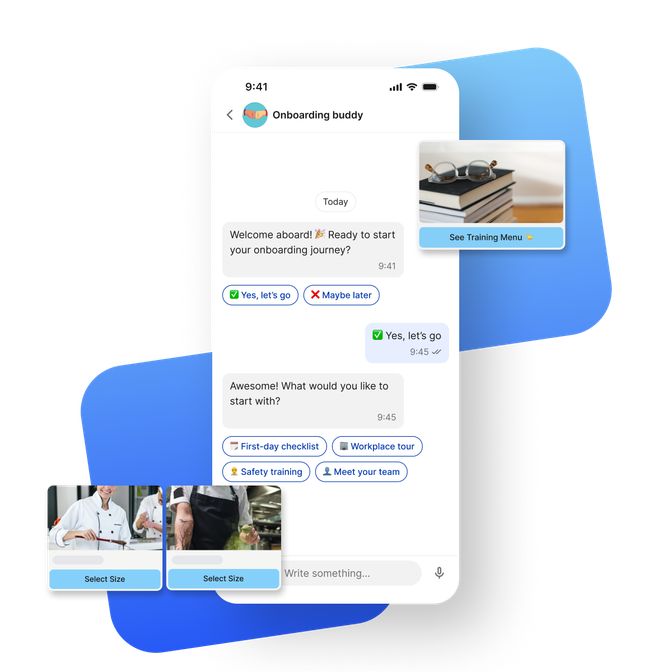
Discover how Flip empowers different roles across your organization — from communications to HR to operations here.
Frontline communications: the tools that were never designed for the people using them
Walk into a large distribution center on any given morning and you will find a workforce that receives critical updates through a combination of printed notices pinned to break-room walls, briefings passed verbally between shift supervisors, and the occasional group chat on a personal messaging app. What is missing here is robust infrastructure, not committed leadership.
The enterprise communication stack, including email, company intranet, Microsoft Teams, and digital signage on office walls, was built for knowledge workers. It assumes a fixed working location, a corporate device, a company email address, and the kind of working day where checking a dashboard is a natural part of the rhythm.
For frontline workers, none of those assumptions hold. A warehouse operative starting at 5am does not open Outlook before a shift. A hotel housekeeper does not log into the company intranet between rooms. A retail team member on the shop floor does not receive push notifications from a system that requires VPN access to function.
The result is what communications researchers describe as the "last mile" problem: information leaves headquarters and gets progressively diluted as it passes through layers of management, until what reaches the frontline employee is either incomplete, outdated, or simply absent. Thirty percentage points separate what leadership believes it is communicating and what employees actually receive (Gallup). That is not a communication gap. It is a communication chasm.
This is precisely the problem a frontline worker app solves, but only when it is built from the ground up for deskless employees, rather than retrofitted from a platform designed for office use.
The features that define genuinely effective frontline communications tools are not complicated, but they are specific. A mobile-first approach that works on personal devices . Onboarding without a company email address. Multilingual content for diverse workforce populations. Offline capability for environments with limited connectivity. Push notifications that reach employees even when the app is closed. Role-based content delivery so that the retail team in Hamburg sees what is relevant to them, and the logistics crew in Birmingham sees theirs.
And, critically, a unified platform that brings communication, task management, and HR self-service together in one place, because the most effective frontline communications strategy is the one that employees actually use.
What the best frontline worker apps actually do: features that move the needle
Describing the features of a frontline worker app is straightforward. Describing why each feature matters, and which combination creates genuine operational impact, is where most comparisons fall short.
Real-time updates and push notifications that reach every employee
The most fundamental function of any employee communication app is ensuring that company news, safety information, and critical operational updates reach staff in real time, not when they happen to log in, and not three days later via a supervisor relay. Push notifications sent directly to a mobile device achieve exactly this, bypassing the inbox bottleneck that renders email useless for deskless workforces.
The goal is not volume of messages but relevance: employees who receive only the updates that concern their role, their location, and their shift stay engaged with the platform. Employees buried in generic announcements switch off.
Multiple 2025 workplace communication studies show that when employees receive consistent, relevant information, the majority (91%) reports feeling more aligned with their organisation's goals and more motivated in their work . That statistic is cited frequently enough to be treated as a baseline expectation rather than an aspiration.
Task management and workflow automation on the shop floor
Communication alone does not drive operational performance. The most valuable frontline worker apps move beyond information delivery to action enablement. This means that employees can not only receive instructions but also acknowledge them, complete checklists, report issues, confirm shift handovers, and trigger workflows directly from their mobile device. This eliminates paper-based processes that slow down operations and create compliance blind spots. A store manager who can assign tasks, track completion rates, and receive real-time confirmations through a single app streamlines operations in ways that a printed task sheet simply cannot.
For industries such as retail, manufacturing, and logistics, the place where operational compliance and task adherence are directly tied to regulatory requirements and customer outcomes, the shift from paper to digital workflows is increasingly a competitive requirement .
Compliance training and onboarding for new hires
Training delivery has historically been one of the most persistent pain points in frontline operations. Instructor-led sessions require employees to be present in the same location at the same time, which is structurally difficult to achieve with shift-based workforces. Digital training modules delivered through a frontline worker app resolve this by allowing new hires to complete onboarding content and existing staff to refresh compliance knowledge at a time and pace that fits their schedule . Completion rates for training delivered through a dedicated mobile app consistently outperform those achieved through email-based or desktop LMS approaches, This is because the content meets employees where they already are, on a device they already carry.
HR self-service: swap shifts, request time off, access payslips
The administrative layer of employment, including managing availability, requesting leave, accessing payslips, and reporting absences, consumes a disproportionate volume of HR team time when handled manually or through systems that frontline staff cannot access independently. A frontline worker app that integrates HR self-service functions gives employees agency over their own working lives while reducing the administrative burden on HR teams. The ability to swap shifts, request time off, and access relevant personal documents from a mobile device transforms what was once a friction-heavy process into a routine interaction. And, crucially, it gives employees a tangible reason to open the app every day.
GDPR compliance and data security for frontline workforces
Any digital platform deployed to a large frontline workforce will, by necessity, process personal employee data. In Europe, and particularly in Germany and the UK, where data protection requirements are enforced with rigour, GDPR compliance is not optional. A frontline worker app that handles employee communication, task data, training records, and HR information must be built with robust identity access management, data encryption, and clear data governance frameworks. GDPR-compliant architecture is not a feature to mention in passing; for enterprise procurement teams and works councils, it is often the deciding criterion.
Frontline operations in practice: a composite picture from the warehouse floor
Consider a food manufacturing company with 4,500 employees across seven sites. Before introducing a dedicated frontline worker app, the internal communications team relied on a combination of printed shift briefings, manager-distributed emails, and a desktop intranet that only 12% of operational staff had ever logged into. Company updates, including safety protocol changes, production schedule adjustments, and HR announcements, reached frontline employees an average of four to five days after they were published. Compliance training completion rates hovered around 34%.
After deploying a mobile-first employee communication app, the company reported that communications reached the full operational workforce within four hours on average. Training completion rates rose to 78% within the first six months. Shift managers reported spending 40% less time distributing information manually. Critically, engagement survey scores showed a 19-point improvement in the question "I feel informed about what is happening in this company."
The point is not that the numbers are dramatic, though they are. It is that none of this required a structural reorganisation, a new HR strategy, or a leadership retreat. It required a single, well-chosen tool built for the people actually using it.
This exemplary pattern holds across customer stories from retail, hospitality staff, construction, and logistics: the companies that close the frontline communications gap most effectively are those that stop trying to retrofit office tools and start investing in platforms designed from the ground up for deskless employees.
Boost engagement: what company culture looks like when it reaches everyone
Culture is one of the most discussed and least operationalised concepts in modern management. Leaders invest in values workshops, employer branding exercises, and all-hands meetings, and then wonder why operational employees do not seem to share the same sense of purpose as the leadership team. The reason is usually structural: the mechanisms through which culture is communicated were built for people who attend those all-hands meetings.
A frontline worker app makes culture tangible in the daily working experience of every employee. Company news, leadership messages, recognition programs, peer acknowledgements, and team milestones all become accessible to a warehouse operative, a shop-floor team member, or a hospitality staff member in the same way they are accessible to a marketing manager. This is not symbolic inclusion, it is the kind of felt belonging that Deci and Ryan's self-determination theory identifies as one of the three core psychological needs driving human motivation. When people feel connected to something larger than their individual task, discretionary effort follows.
The organizations that succeed in building genuinely inclusive company cultures share one operational characteristic: they reach everyone, as an infrastructure decision.
Digital signage is sometimes proposed as an alternative, like a screen in the break room displaying company updates. It has its place, particularly for site-wide announcements and safety information. But it is passive, and it is location-dependent. A frontline worker app reaches employees when and where they are, with content relevant to their specific role. The difference between a screen on a wall and a notification on a personal device is the difference between broadcasting and communicating.
The employee app landscape in 2026: what separates good from best
The market for frontline communication tools and employee apps has expanded considerably over the past five years. Where organizations once faced a binary choice between extending an office-based intranet to mobile or using consumer messaging apps such as WhatsApp for operational communication, they can now choose from a range of purpose-built platforms. The challenge has shifted from "find a tool" to "identify the best app for our specific workforce."
Several criteria consistently separate genuinely effective frontline worker apps from those that deliver initial enthusiasm and then decline into low adoption rates.
Ease of access without a company email: The most effective platforms allow frontline employees to register and authenticate using a mobile number, an employee ID, or a QR code — eliminating the onboarding barrier that defeats most corporate digital tools before they start.
Mobile-first design, not mobile-adapted: There is a meaningful difference between a platform designed from the ground up for smartphone use and one adapted from a desktop interface. Mobile-first products are built around the interaction patterns, screen sizes, and connectivity constraints of mobile working. They load quickly, navigate intuitively, and function with minimal data consumption.
A unified platform, not a collection of integrations: The frontline employee experience suffers when employees must move between multiple apps to complete different tasks — one app for communications, another to swap shifts, a third to access payslips. The best frontline worker apps consolidate these functions in a single experience, reducing friction and increasing the likelihood that employees actually use the tools provided.
Support for AI and automation: The most forward-looking platforms in 2026 incorporate AI capabilities that go beyond content recommendation algorithms. The ability to trigger workflows through conversational prompts, receive AI-generated answers to HR queries, and automate repetitive administrative tasks transforms a communication app into a system of action — one that genuinely makes life easier for both employees and the operational teams who support them.
Enterprise-grade security and GDPR compliance: For multi-site organisations deploying a platform to tens of thousands of employees, data security and regulatory compliance are non-negotiable. Platforms that treat GDPR compliance and robust identity access management as core architectural features — rather than add-ons — are the ones that survive enterprise procurement scrutiny and works council review.
Flip: a frontline employee experience platform built for what comes next
In the second half of this article, the conversation shifts from the category to a specific platform, one that has built its product strategy around exactly the challenges described above.
Flip is a frontline employee experience platform purpose-built for deskless workforces. What began as a communication-first product has evolved into a comprehensive system of action: a single app through which frontline employees can communicate, complete tasks, access HR systems, and interact with AI, without needing a corporate email address, a laptop, or multiple logins.
The platform empowers employees at every operational level. Through Flip Comms, organizations deliver news, announcements, and targeted updates to the full frontline workforce in real time. Flip Flows enables employees to trigger and complete workflows, from absence requests and shift confirmations to onboarding steps and compliance acknowledgements, directly from their mobile device, eliminating paper-based processes and the bottlenecks that accompany them. Flip Identity removes the authentication friction that historically prevented frontline staff from accessing digital systems at all, replacing multiple credentials with a single, secure touchpoint.
And then there is Flip's AI layer. As the broader category of frontline worker apps moves from information delivery to intelligent action, Flip is positioning itself as an AI gateway for the frontline, a platform through which employees can ask questions, trigger processes, and complete tasks through conversational interfaces. Frontline employees using AI-enabled tools report lower levels of burnout and higher productivity, according to the 2025 goHappy/LHRA frontline workforce research. Flip's architecture is designed to make that transition achievable at enterprise scale, for companies ranging from mid-size retailers with 1,000 employees to large manufacturing organizations with 50,000 people across multiple countries.
For HR and IT professionals evaluating frontline communication tools, the question of scalability is rarely about the technology itself, it is about whether the platform can grow with the organization's needs, adapt to evolving regulatory requirements, and maintain the kind of UX quality that keeps adoption rates high two years after deployment, not just at launch. Flip is built with that trajectory in mind. It is a platform that becomes more relevant as AI gains broader operational relevance, not less.
Customer stories from organizations in retail, manufacturing, and logistics consistently identify the same outcome: when frontline teams gain easy access to a unified, mobile-first platform designed for their working reality, communication improves, engagement rises, and operational performance follows.
Frontline staff in the age of AI: what the next five years demand
The evolution of the frontline worker app from communication channel to system of action is not a future possibility, it is already under way. The distinction matters because it changes the frame through which HR and IT professionals should evaluate these platforms.
A communication tool delivers messages. A system of action enables work. The most strategically significant question a company can ask about its frontline digital infrastructure in 2026 is not "how do we reach our employees?" but "what do we want our employees to be able to do from their phone?"
The answer, increasingly, is: almost everything that currently requires a computer, a printed form, a manager conversation, or an HR helpdesk call. Leave requests, payslip access, training completion, safety incident reporting, compliance acknowledgements, shift management — each of these can be handled through a well-designed frontline worker app, and each one represents a meaningful reduction in administrative friction for both employees and the organizations supporting them.
The AI dimension adds another layer of possibility. Research from 2025 consistently shows that frontline employees using AI-enabled tools experience lower burnout rates and report higher levels of job satisfaction than those without access. This is because AI handles the low-value, repetitive administrative layer, freeing frontline staff to focus on the customer interaction, the quality inspection, the safety check. The work that actually requires human judgement and human presence.
For organizations investing in their frontline operations , the trajectory is clear. The best frontline worker apps of 2026 are platforms that can grow with these expectations, that treat AI not as a feature to add later but as a design principle embedded from the ground up.
The companies that recognize this now, and build the digital infrastructure to support it, are not just improving communication. They are building the operational foundation for a workforce that is better informed, more engaged, and better equipped to deliver the customer and commercial outcomes that justify the investment.
The Victorian Post Office eventually abolished the Dead Letter Office. Not because undeliverable mail stopped being a problem, but because the system improved enough to make it obsolete. The same choice sits in front of every organization with a large frontline workforce today. Company news, safety updates, and strategic decisions do not have to expire quietly before they reach the shop floor. The tools exist to ensure they arrive. The evidence for acting on that is clear. The only remaining question is whether the decision comes before or after the disengagement data makes it unavoidable.
Conclusion: the frontline is where the future of work actually happens
The shop floor is not the edge of the organization. It is the center of it.
The cumulative cost of poor frontline communication, measured in disengagement, turnover, missed compliance, operational errors, and the grinding inefficiency of paper-based processes, runs into hundreds of billions of dollars annually. The solution is not a policy change or a leadership offsite. It is infrastructure: a frontline worker app that meets employees where they are, with what they need, on a device they already carry.
The organizations that treat frontline employee experience as a strategic investment, rather than an afterthought, are consistently outperforming their peers on the metrics that matter. The 27-point engagement gap between companies that invest in frontline tools and those that do not translates directly into lower turnover, higher productivity, and a stronger operational foundation for whatever comes next. including, and especially, the AI transformation that is already reshaping how frontline work gets done.
The best time to close the communication gap was five years ago. The second-best time is now.
Sources: Gallup, State of the Global Workplace 2025 ; SafetyCulture, Feedback from the Field 2024 .
FAQ: frontline worker app
A frontline worker app is a mobile-first platform designed specifically for deskless employees who do not have access to a company computer or corporate email address. A traditional company intranet assumes desktop access, a fixed working location, and a corporate login. A frontline worker app removes all of those prerequisites — employees can register using a mobile number or employee ID, access content on a personal device, and receive push notifications during their shift. The experience is designed around how frontline staff actually work, not around how office staff use technology.
Yes — and this is one of the most important design requirements for any platform serving a deskless workforce. The best frontline worker apps allow employees to onboard using a mobile number, a QR code, or an employee ID. Requiring a corporate email address creates an immediate barrier for frontline staff in retail, logistics, hospitality, and manufacturing, where a significant proportion of the workforce has never been issued one.
GDPR-compliant frontline worker apps handle employee data — including communication records, task completion data, training progress, and HR information — with appropriate data encryption, role-based access controls, and clear data governance frameworks. For European organizations, and particularly those operating in Germany where co-determination rights mean works councils must approve digital deployments, selecting a platform with robust GDPR-compliant architecture is essential to a successful rollout.
Any industry with a significant deskless or shift-based workforce benefits from a dedicated employee communication app. The strongest use cases appear in retail, manufacturing, logistics and supply chain, hospitality, and construction — industries characterized by large operational workforces, multi-site structures, and limited access to traditional digital communication infrastructure. Companies with 1,000 or more frontline employees typically see the most measurable impact, because the gap between headquarters communication and shop-floor reality is largest at that scale.
The essential features of a frontline worker app in 2026 include: mobile-first design with no company email required; real-time push notifications for critical updates and company news; task management and digital workflow capabilities to replace paper-based processes; compliance training and onboarding modules with trackable completion rates; HR self-service functions including shift management, leave requests, and payslip access; GDPR-compliant data security; and AI-assisted capabilities that enable employees to trigger workflows and get answers to HR queries through conversational interfaces. Platforms that consolidate all of these functions in a single unified experience consistently outperform those that require employees to navigate between multiple tools.

Reach your operational teams 80% faster and more reliably
Flip's mobile app combines messaging, chat, HR tools , and your knowledge base in one secure application. No additional tools or licenses required.

Dr. Franzi Finkenstein
Dr. Franzi Finkenstein is part of the Content & Search team at Flip, writing about digital communication, employee engagement and AI–human connections. Drawing on a humanities PhD and extensive editorial experience, she focuses on how digital technology is reshaping the future of work and explores how employee health and wellbeing in modern workplaces can be improved.
Don’t forget to share this content

More on the topic of Employee app

Digital Workplace: how AI is changing everything
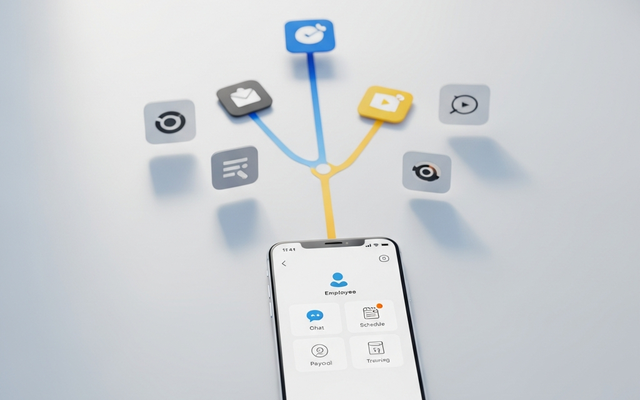
Employee Super App: One Platform, Every Workplace Tool

Why digital experience matters for employee engagement