






WhatsApp alternative for business: why secure messaging is now a board-level decision
Published:
Since 2021, the US Securities and Exchange Commission has fined more than 100 financial firms over $2.2 billion in its "off-channel communications" crackdown. The trigger was simple: nobody could prove what staff had said on WhatsApp, because the messages lived on an app the banks did not control. Most companies run on the same arrangement without noticing: shift swaps, safety alerts and half the real decisions of the day travel through WhatsApp, on servers no IT team controls and leaving a trail no regulator could audit. For frontline teams, the drivers, shift workers and shop-floor staff who have no corporate email and no desk, that consumer app has quietly become the company's main communication channel.
This guide covers why WhatsApp Business and the Facebook Messenger fall short for internal use, where end-to-end encryption stops protecting you, and how to choose a WhatsApp alternative business leaders can defend, from secure messengers to a purpose-built employee app for the frontline. One question runs underneath it all: when AI starts doing real work on your team's behalf, will it run through a channel you control, or one you merely borrow?
 Dr. Franzi Finkenstein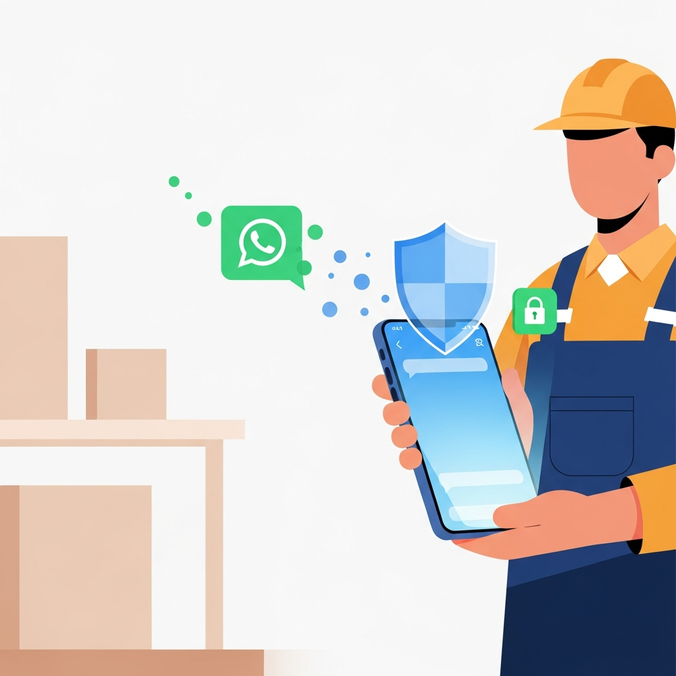
Key Takeaways
Regulators have already put a price on informal messaging. Since 2021, more than 100 financial firms have paid over $2.2 billion in penalties to the US Securities and Exchange Commission for business conducted on unapproved channels such as WhatsApp, and the UK's Information Commissioner's Office has formally reprimanded organizations for sharing sensitive data through the same app. A WhatsApp alternative business case now starts with risk, not preference.
End-to-end encryption protects what people say. It leaves untouched the metadata around the message: who spoke to whom, when, how often, from which device and location. For business communication, that gap matters as much as the message itself, and no version of WhatsApp Business closes it.
The hardest problem in frontline communication has nothing to do with chat features. It is digital identity. Most operational teams have no corporate email address and no company device, so any serious alternative to WhatsApp has to solve access before it solves messaging.
WhatsApp in business: the numbers that matter
WhatsApp is the most popular messaging app in the world, with 3 billion monthly active users as of 2025, according to Meta. Ubiquity is exactly why it slips into the workplace unannounced.
Since 2021, the US Securities and Exchange Commission has fined more than 100 financial firms over $2.2 billion for conducting business communication on unapproved channels such as WhatsApp.
The free WhatsApp Business app caps a broadcast list at 256 contacts, links a maximum of five devices, and offers no chat assignment, no audit trail and no real analytics, according to WhatsApp's own documentation.
The US Cybersecurity and Infrastructure Security Agency has warned that threat actors use commercial spyware and remote access trojans to target users of instant messaging apps, naming WhatsApp specifically.
In the UK, Action Fraud recorded a 230% rise in "Friend in Need" impersonation scams aimed at WhatsApp users in a single year.
What Does A Frontline Mobile App Actually Do?
Most frontline apps focus on bridging the gap between employees in the field and office based teams. They bring together communication, workforce management, self service HR, training, and operational tools in a single mobile platform that works for people who are rarely at a screen.
Employees receive push notifications for company news, check leave balances, submit absence requests, and complete task checklists, all from their phone. Managers can approve leave, update rosters, and track who has seen critical updates through read receipts. QR code sign in removes the need for a corporate email address, which remains the single biggest barrier to digital access for deskless workers.
A built in knowledge base gives employees instant access to SOPs, training materials, safety protocols, and company policies. Rather than searching shared drives or waiting for a manager, frontline workers can find the answer they need in seconds. For organizations pursuing a digital transformation strategy, this shift from paper based information sharing to structured, searchable knowledge is one of the highest impact changes a frontline mobile app delivers.
Automated workflows replace manual processes for tasks such as absence approvals, shift swaps, and compliance sign offs. This improves accuracy and consistency, minimizes human error, and ensures that regulatory requirements are met without relying on paper trails or individual memory.
Flip Flows provides the security businesses need, now and in the future.
What counts as a WhatsApp alternative for business
A WhatsApp alternative for business is a messaging platform that brings internal communication under the organization's own control. It processes data on terms the company sets, can be administered by IT, integrates with existing systems, and works for employees who have never opened an admin console in their lives. The category spans secure messaging tools built for regulated industries, broader team collaboration suites, and frontline employee platforms that treat communication as one capability among many.
Business communication and the letter that could not be read
In the Roman army, a commander who wanted to keep an order from enemy eyes did not invent a better courier. He used a scytale, a wooden rod of a precise diameter around which a strip of parchment was wound. The message made sense only when wrapped around a rod of the same width, and unwound it was a meaningless ribbon of letters. The genius of the device was that the sender and the receiver controlled the one thing that made the words legible: the rod itself. Whoever held the rod held the conversation.
How WhatsApp quietly became the default for team communication
Two thousand years later, most organizations have quietly handed the rod to someone else. The instant messaging that now carries shift swaps, safety alerts, customer complaints and half the real decisions of the working day runs on an app the company does not own, cannot administer, and would struggle to audit if a regulator ever asked. The conversation happens. The control sits elsewhere. That is the situation in thousands of businesses across the UK and the US right now, and it has a name most people use every day without a second thought.
WhatsApp became the default channel for team communication not through any procurement decision. It arrived the way water finds a crack. Employees knew it, it was free, and it worked when the official tools did not. Internal communication that should have flowed through managed systems found its way onto a consumer messaging app instead, and once a group chat exists, it becomes the room where things actually get decided. The question for any leader reading this is whether that arrangement can survive contact with a serious data protection review. The evidence says it cannot.
WhatsApp Business: more features, the same data foundation
If consumer WhatsApp is the problem, surely WhatsApp Business solves it? It does not. WhatsApp Business and the WhatsApp Business API were built for customer communication, with chatbots, quick replies and notifications fed into a CRM, and they run on the same Meta servers under the same terms as the consumer app. A business plan does not move your team communication to European control or give IT a real administration console.
The free app also fails operationally: it ties everything to a phone number, links only five devices, caps broadcast lists at 256 contacts, and offers no shared inbox, no chat assignment and no task management or project management tools. A tool built on personal accounts and personal phone numbers cannot serve as the foundation for internal communication. It is the very arrangement that created the shadow IT problem in the first place.
The Facebook Messenger problem: same parent, same exposure
The Facebook Messenger resolves the internal risk even less, for the simplest reason: it belongs to Meta too, so the personal data, usage behavior and metadata flow into the same infrastructure. It keeps a narrow, legitimate role through its Facebook integration, letting businesses receive customer inquiries, run live chat and route those interactions into a CRM. As multi channel messaging aimed at the public, that works. For internal team communication, it carries every weakness of WhatsApp with none of its familiarity.
Telegram appears on many alternatives lists, but Business Telegram does not really exist as a managed product. Its large group chats, broadcast messaging and generous file limits suit communities and public announcements, yet none of that gives an organization administration rights, an audit trail or a defensible answer about where data lives, and its default chats are not even end to end encrypted. As a channel for internal operations it carries the same flaw as WhatsApp in different clothing.
End-to-end encryption: necessary, and not the whole story
End-to-end encryption is now table stakes. WhatsApp, Signal and Microsoft Teams all use it, but encryption alone does not equal data security. End to end encrypted messaging scrambles the content in transit, so no intermediary can read the words. It does not protect what surrounds the message. As security researchers put it, encryption is not the problem; metadata is. Metadata reveals who talks to whom, when, how often, and from which device and location, and stitched together it describes a person's working life and movements in forensic detail without a single message being read.
For an enterprise this is the decisive gap. A provider can promise it cannot read your messages and still hold a rich behavioral map of your organization, and when that provider sits inside an advertising company, where the metadata travels becomes due diligence. Robust security features for business have to govern the metadata, fix the server location in a jurisdiction the company can defend, keep data out of advertising, and give IT genuine audit functions. Self-destructing messages and private chats are useful touches, not a data protection strategy. WhatsApp, in any version, delivers the encryption and leaves the rest on the table.
What a secure communication platform actually has to deliver
Strip away the marketing and a serious WhatsApp business alternative has to satisfy five demanding requirements. Each looks obvious, yet together they eliminate most of the market:
Data control: data kept under the organization's control, processed in a jurisdiction the company can defend to a regulator.
IT administration: IT can create, suspend and offboard users and govern access rights without a manual process for every individual.
No email or phone number needed: it reaches people with no corporate email address and no company phone number, which describes most of the operational workforce.
End-to-end encryption: content encrypted end to end as a baseline.
Simplicity: usable by someone who will never read a manual, because a tool that asks too much will be ignored for the app they already know.
Data security and usability are too often treated as a trade-off, and a messaging platform that is secure on paper and baffling in the hand protects no one because nobody uses it. The real test of any alternative to WhatsApp is whether it holds security, compliance and simplicity at once, for the same person, on a shared device, during a twelve-hour shift
Comparing the best WhatsApp alternatives by use case
The market for business messaging is crowded, and the honest answer to "what are the best alternatives to WhatsApp" is another question: alternatives for whom? The right messaging platform for a software company with company laptops looks nothing like the right one for a logistics operator running three shifts across a dozen depots. The table below maps the main categories rather than ranking individual brands, because the fit depends on the workforce.
Which alternative to WhatsApp fits which workforce
| Capability | Consumer apps (WhatsApp, Telegram) | Secure business messengers | Microsoft Teams | Frontline employee platforms |
|---|---|---|---|---|
| IT administration and audit trail | No | Yes | Yes | Yes |
| Metadata and server control by the company | No | Yes | Partial | Yes |
| Works without corporate email or phone number | No | Rarely | No | Yes |
| Built for internal team communication | No | Yes | Desk-first | Frontline-first |
| Fit for deskless and shift workers | Poor | Limited | Poor | Strong |
A pattern appears. Secure business messengers solve compliance and control well, yet most still assume an email address or phone number at sign-up, which excludes the people who most need reaching. Team collaboration suites such as Microsoft Teams bring strong productivity tools, document sharing and deep office integration, and they suit anyone with a corporate identity and a screen, not someone restocking a shelf or driving a route. That person needs a frontline employee platform, the only column above that answers every row without an asterisk. A mixed workforce usually runs a desk-first tool for knowledge workers and a frontline-first one for everyone else, with seamless integration between them.
Beyond secure messaging, operational teams also need voice and video calls that work on a budget handset over patchy wifi, broadcast messaging that reaches a whole site, document and media sharing that keep sensitive files out of personal cloud accounts, and task management in the same surface. The more an organization pushes onto a consumer messaging service, the harder it gets to protect sensitive information scattered across personal accounts on multiple devices.
How Flip gives frontline teams a secure alternative to WhatsApp
Flip is a frontline employee experience platform, an AI-native employee communication app and mobile intranet for the people who keep operations running. It is mobile-first and offline-capable, and it gives deskless employees a single secure place to communicate, complete tasks and reach company systems, with no corporate email address or personal phone number required. Real time messaging, group chats, voice and video calls, file sharing and a company-wide newsfeed sit alongside HR self-service and automated workflows, all GDPR-compliant, processed under the company's control, and administered through one IT console with the audit trail WhatsApp can never provide.
What sets it apart is where it begins: with the digital identity of frontline workers, the question every consumer messaging service ignores. Solving access first is what turns a messaging app into business-critical internal communication for frontline teams.
The AI dimension: why conversational AI raises the stakes
Business communication is becoming conversational AI for business. The same interface that carries a chat will soon carry an agent that answers a policy question, files an absence request or confirms a shift in natural language. A consumer messaging app cannot become that front door: it has no secure link to company systems, no managed identity to authorise actions, and no governance over the sensitive data those actions touch.
The AI divide between desk and frontline teams
The deskless workforce makes up an estimated four-fifths of the global working population, yet receives a tiny fraction of workplace technology investment, and Gallup's research shows frontline engagement lagging behind. As AI delivers productivity gains to office workers, that gap risks widening. An organization still routing frontline communication through WhatsApp has no path to put AI safely into those workers' hands, while one that has given them a controlled platform has the runway ready.
How a secure platform turns messaging into team productivity
The managed foundation that protects sensitive data is also what lets a platform enhance productivity for the frontline. When a worker can send messages, confirm a shift, find a policy and ask an AI assistant to complete a task inside one app, the friction once scattered across paper, noticeboards and personal phones disappears. An AI intranet built for operational teams turns the phone in a worker's pocket into a genuine digital workplace platform.
An AI-powered employee app, whether you call it a staff app, an hr app, an internal communication app or simply the co-worker app everyone opens at the start of a shift, shares one defining quality: it is owned by the employer, governed by IT, and ready for the agentic AI that will soon do real work on the worker's behalf. The question for leaders is how quickly the workforce can be moved onto a foundation AI can safely build on.
Conclusion: hold the rod
WhatsApp remains the most popular messaging app on earth and, in thousands of businesses, the unofficial channel where shift changes are agreed and the day is run. This is the result of a gap organizations left open, by never providing a simple, secure alternative for the people on the floor, the road, the ward and the shop.
The Roman commander understood something his modern counterpart often forgets. Security was about controlling the instrument that made the conversation possible, the rod that only sender and receiver could hold. Route your team communication through an app you do not own and cannot audit, and you have handed that rod to a company whose business is built on the very metadata you are trying to protect.
Provide a platform you control, one that reaches every worker and is ready for the AI that is coming, and you hold the rod yourself. For a business heading into the next few years, that is the difference between watching the future of work happen to your frontline and putting it into their hands.
Sources: Security Affairs, CISA warns spyware and RATs are used to target WhatsApp and Signal users (US Cybersecurity and Infrastructure Security Agency; TechRadar, WhatsApp encryption isn't the problem, metadata is; ICO, Data Protection Act 2018.
FAQ: WhatsApp alternatives for business
For internal team communication, WhatsApp Business carries real data protection risk. It runs inside Meta's infrastructure, headquartered in the US, and transmits account information and metadata accordingly. UK and EU regulators have repeatedly flagged the data protection shortcomings of consumer messaging apps in a work context, and the ICO has formally reprimanded organizations for using WhatsApp to handle sensitive data. As a customer communication channel it has a legitimate role. As the backbone of internal communication it exposes the company to measurable liability.
End to end encryption protects the content of a message, not the metadata surrounding it. Who communicates with whom, when, how often, from which device and location all remain visible to the provider and travel unencrypted. A complete approach to secure communication needs encryption plus a defensible server location, a guarantee that metadata is not reused for advertising, and an auditable architecture that the IT administration can inspect.
Yes, with the right platform. Most instant messaging apps and team collaboration tools assume a corporate email address or a phone number at sign-up, which excludes much of the deskless workforce. Frontline employee platforms solve access first, authenticating workers through methods such as passkeys, QR codes or invitation codes, so that an operational team can be onboarded securely without anyone needing a company email account or surrendering a personal number.
The best WhatsApp alternative depends on who you need to reach. For office teams who already hold a corporate identity, secure business messengers and a suite such as Microsoft Teams cover most needs. For frontline and operational teams, a frontline employee experience platform is the stronger fit, because it pairs secure messaging, voice and video calls, file sharing and task management with an onboarding model that works without email or personal phone numbers. The deciding factor is whether the tool can reach the whole workforce, not just the half that sits at a desk.

Reach your operational teams 80% faster and more reliably
Flip's mobile app combines messaging, chat, HR tools, and your knowledge base in one secure application. No additional tools or licenses required.

Dr. Franzi Finkenstein
Dr. Franzi Finkenstein is part of the Content & Search team at Flip, writing about digital communication, employee engagement and AI–human connections. Drawing on a humanities PhD and extensive editorial experience, she focuses on how digital technology is reshaping the future of work and explores how employee health and wellbeing in modern workplaces can be improved.
Don’t forget to share this content

More on the topic of Workflow engine
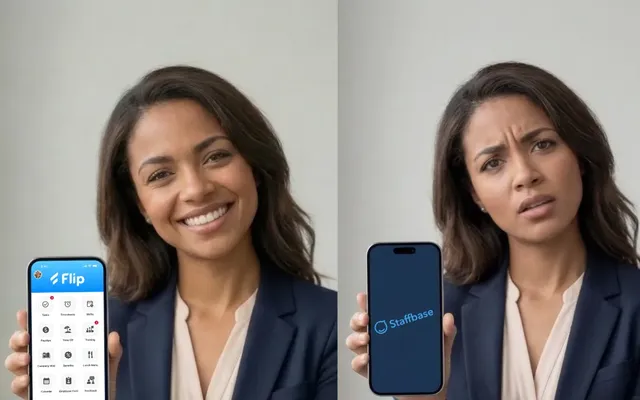
Best Staffbase Alternative 2026: Flip vs Staffbase Compared
Flip vs Workvivo 2026 – Best Workvivo Alternative

Phishing resistant login: 2026 guide for frontline teams