





The best workplace AI doesn't start with AI. It starts with answers.
Published:
What UNLEASH Paris 2026 taught me about AI for the frontline...
 Sharon O'Dea

Key Takeaways
AI needs solid information to start: AI tools only work well when they are backed by clear, accurate, and official company facts, rather than trying to sort through chaotic, unmanaged archives.
Every answer needs an owner: Reliable information requires a specific person responsible for keeping it up to date, ensuring the system doesn't guess or give outdated details.
Language shouldn't be a barrier: Tools need built-in translation so that diverse workforces can easily access information in their preferred language.
Curated content beats massive archives: A small, carefully maintained set of pages answering real questions is much more effective than feeding the AI years of old documents and unorganized chats.
Frontline workers need practical solutions: Employees without desks rely on mobile-friendly tools that work instantly, as they don't have the luxury of digging through intranet pages or asking office colleagues.
Thousands of WhatsApp groups. Thousands of emails. Phone calls everywhere, and posters nobody read. More than 45 nationalities in Austria alone, with content often only in German or English. Managers chasing work permits and student licences day in, day out, in what the team called a treasure hunt.
That was the starting point KFC Austria & Slovakia described at UNLEASH Paris, where they presented myKFC, their employee app built on Flip AI. It’s a picture familiar to anyone who has worked with a frontline workforce. The information was everywhere. Responsibility for it was nowhere.
I hear versions of this story all the time in my client work. In one organisation, we found key information for frontline teams in a Facebook group. In another, customer service teams had built themselves an intranet in Excel, complete with first-level navigation in a beautifully organised series of tabs. Ridiculous, yes, but also ingenious. Someone had understood exactly what their colleagues needed and built it using the tools they had. Sadly for everyone involved, the tool they had was Excel, pressed into service as a content management system.
What's unusual about KFC isn't the problem. It's that they fixed it.
AI was everywhere at UNLEASH, and most of the conversation was about what it can do. KFC's story is a better guide to what it needs. AI that unblocks people only works if there's something trustworthy behind it.
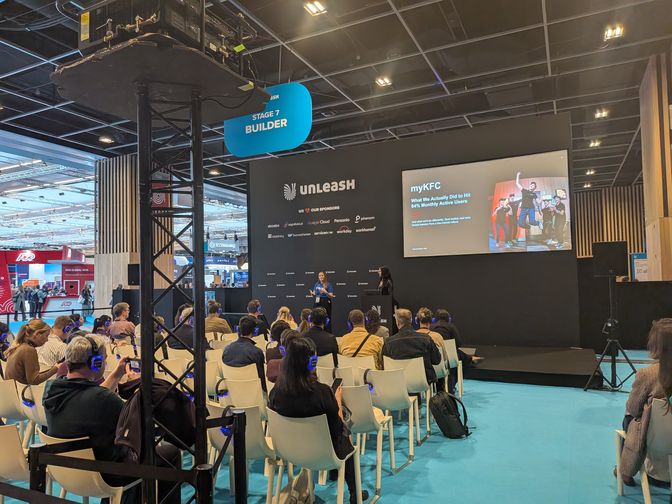
KFC presentation and Unleash Paris 2026
Answers need an owner
The appetite for simple answers is enormous: one of Europe's largest employers said its HR chatbot fielded more than 600,000 questions in a single month. The demand isn't in doubt. The reliability of the answers is another matter.
Elsewhere at the event, I watched an agent connected to nearly every system an organisation owned spend two minutes and 36 seconds searching for its employee headcount, only to tell me I wasn't authorised to know. The figure was in the annual report. I could have Googled it, made a cup of tea and come back.
That wasn't an integration problem. The agent could reach everything. The problem was that nobody had designed for organisational facts: the plain, shared, authoritative things everyone needs to know, each with someone responsible for keeping it right. Without them, even the most sophisticated AI can end up guessing, giving up or spending an extraordinary amount of computing power answering a question the organisation should have settled years ago.
What KFC built
KFC took the language off the table first. Posts appear in whatever language an employee's phone is set to, with tap-to-translate across more than 35 languages.
Using Flip AI, they brought those things together in one employee app: multilingual communication, answers drawn from a managed knowledge base, and a way to get permits uploaded rather than chased. The technology matters here not because it does something spectacular, but because it makes several everyday frustrations disappear.
The adoption figures are strong:
An 89% onboarding rate, with 897 activated users
84% monthly active users
Employment-permit tracking went from zero to 100% digital
Among employees surveyed, 82% rated myKFC four stars or higher, and 71% gave it five
Those numbers tell you people are using the front door. They don't, on their own, tell you how good the answers behind it are.
That's why the number I keep coming back to is the smallest one: 55. That's how many knowledge pages sit behind the AI. Not half a million documents, twelve years of archived PowerPoints and every Teams conversation since someone first discovered the GIF button. Fifty-five managed pages answering the questions people actually ask. That's what the AI stands on.
Of course, those pages would be considerably less useful if employees had to know where to find them, what they were called or which language they were written in. That's what the AI changes. It removes the need to understand the organisation's information architecture before you can get an answer.
Small doesn't mean easy, though. Those pages only stay useful if someone keeps them current, and that's the unglamorous, never-finished work most organisations skip.
The layer underneath
In Digital Communications at Work, Jonathan Phillips and I describe five layers of an organisation's communications: plan, collaborate, publish, distribute and discuss. Publish is the one most often overlooked, because it's the least glamorous. It's where content is owned, managed, versioned and trusted.
The app is the front door, and for people without a desk a good front door matters enormously. It has to be on their phone, in their language, and quick enough to use between shifts.
But a better interface doesn't remove the need for managed information. It makes that need more urgent. When employees can ask questions in natural language and get immediate answers, every gap, contradiction and outdated policy becomes something the system might confidently repeat.
The knowledge base and the AI are doing different jobs. One establishes what the organisation knows to be true. The other makes that knowledge available to people who don't know where to look, what to search for or even what language the original answer was written in. Neither solves the problem alone. Together, they turn a collection of maintained answers into something employees can actually use.
Skip the publishing layer and you don't get rid of publishing. You just push it into a thousand WhatsApp groups, personal inboxes and conversations nobody else can find. Which is exactly the situation KFC was trying to escape.
The more answers AI generates on the fly, the more it matters what they're generated from.

Reach your operational teams 80% faster and more reliably
Flip AI's mobile app combines messaging, chat, HR tools, and your knowledge base in one secure application. No additional tools or licenses required.
Why the frontline makes this obvious
Office workers can paper over the gaps. They can ping a colleague, dig through SharePoint or ask in a Teams channel until someone takes pity on them. Half the modern office runs on informal networks of people compensating for systems that were supposed to make those networks unnecessary.
Frontline workers have much less room to compensate. They may have no desk, no corporate laptop and no time to spend twenty minutes looking for an answer. The technology has to work on their device, in their language, in the ten minutes before a shift starts. They need the shared basics to work because the elaborate workarounds available to head office aren't available to them.
This is where a mobile-first approach matters. Not because everyone needs another app, but because access to workplace information shouldn't depend on having a desk, a laptop or a working knowledge of the corporate directory.
Which is why the frontline is where you find out whether workplace AI actually works. The rest of us just take longer to notice.
How to judge workplace AI
If you're an HR or internal comms leader weighing up AI for your people, here are four questions worth more than any demo:
Does it answer the questions people actually ask? Look at your search logs and your helpdesk tickets before you look at the feature list.
What is it answering from? Who owns each answer, and when was it last checked? If nobody can tell you, the AI is guessing.
Does it work for the people furthest from head office? That means their language, their device and their shift pattern, not just the people who sat through the pitch.
Does it remove a step, or add another place to look? The best tools make something stop happening: the chasing, the forwarding, the asking around. Another interface isn't an improvement if the work underneath stays exactly the same.
Most of what I saw at UNLEASH was about what AI can do. KFC's story, like the best of what I see in my client work, was about what it needs: someone to own the answers.
Get that right, and everything clever has something to stand on. Get it wrong, and you've built a very expensive way of saying "I don't know"

Sharon O'Dea
Sharon O'Dea is a digital workplace strategist, speaker, and co-author of Digital Communications at Work. A former Head of Digital Communications at Standard Chartered, she advises global organizations on employee experience, mobile channels, and internal communication strategy.
Don’t forget to share this content

More on the topic of

Digital Workplace: how AI is changing everything

8 digital workplace examples to inspire transformation

What is the digital workplace in manufacturing? 7 examples